
If you saw the headlines about heavy metals in cat food last week, you probably did what I did and headed straight to the cupboard to read a label. Clean Label Project found lead in 99% of the 100 foods it tested, and the news coverage made it sound like every bowl in the country had a problem.
The report itself is more useful than the headlines, and also more limited. I went through the full report and the two Clean Sixteen lists that came out with it. Below you’ll find what was actually measured, what the numbers can and can’t tell you about your cat, both full lists of the foods that tested cleanest and a few things you can do this week that cost nothing.
Both full Clean Sixteen lists, wet and dry, are further down with the protein and format for every food.
FYI, if you shop through our links, we earn a commission at no extra cost to you.
What Is the Clean Label Project Cat Food Study?
The 2026 Clean Label Project cat food study is a category benchmark of contaminant levels in 100 cat foods sold in the US. Clean Label Project is a nonprofit that tests consumer products and certifies brands it considers cleaner.
The group bought 31 dry foods (kibble), 40 wet foods (canned and pouch) and 29 air-dried or freeze-dried foods from 62 brands. An independent lab with ISO 17025 accreditation tested them for more than 122 industrial and environmental contaminants. These include the heavy metals arsenic, cadmium, lead and mercury; the herbicide glyphosate, phthalates, bisphenols, and acrylamide. Each food was ranked against the others in the category.
Clean Label Project says no applicable regulatory standards exist for these contaminants in cat food, so it compares each product to the rest of the category instead of to a government limit.
Why the Study Measures Per Calorie, Not Per Pound
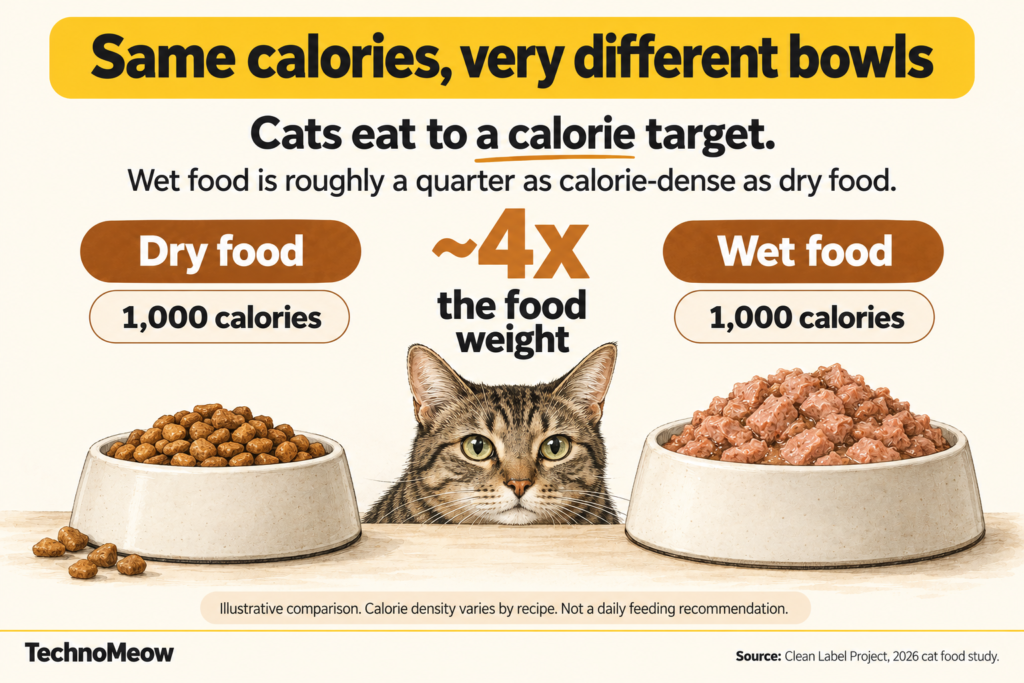
Clean Label Project reports contaminants per 1,000 calories because per-pound numbers make wet food look cleaner than it is.
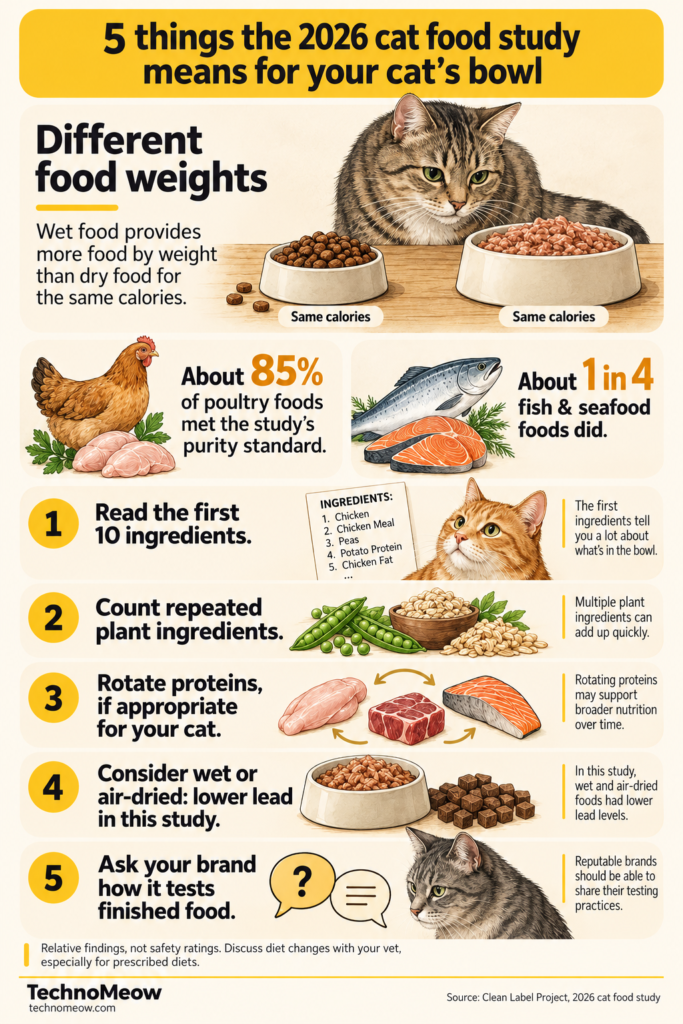
Wet food is mostly water. The foods in the study ranged from 547 to 5,290 calories per kilogram, and wet food is roughly a quarter as calorie-dense as dry. A cat eating wet food needs about four times the weight of food to get the same calories, and all that water dilutes whatever is in the ingredients. Cats eat to a calorie target, so per calorie is closer to what actually reaches the cat.
It’s a bit like judging soup and crackers by the pound. The soup comes out lighter on everything, mostly because of the water. Milo measures food in one unit, and it’s whether the bowl is empty.
What the Study Found
Five findings stood out to me. Every figure below comes from the report and is measured per 1,000 calories.
Heavy metals turn up in almost every food
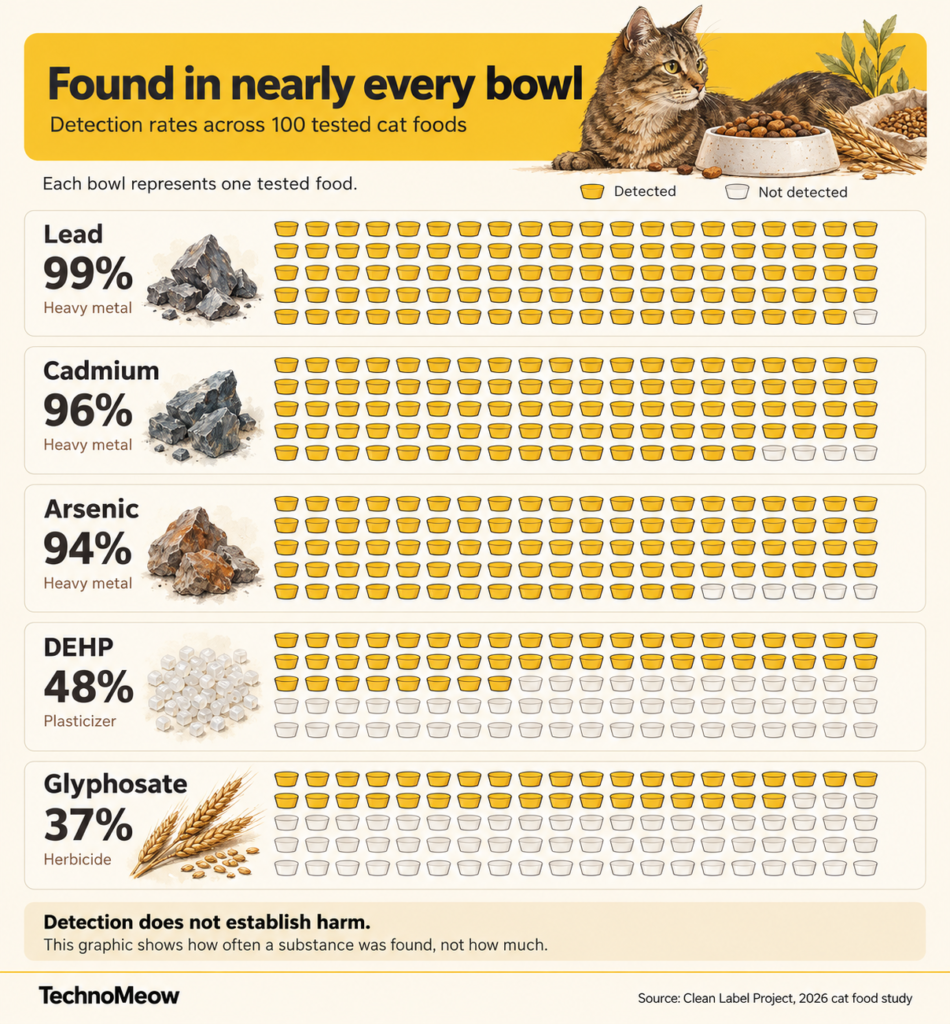
Lead was detected in 99% of products, cadmium in 96% and arsenic in 94%. Since nearly every food contains them, the comparison that matters is how much one food has next to the rest. That gap is wide. For lead, the highest products carried about 3.5 times as much as a typical one.
Fish and mercury is the strongest pattern
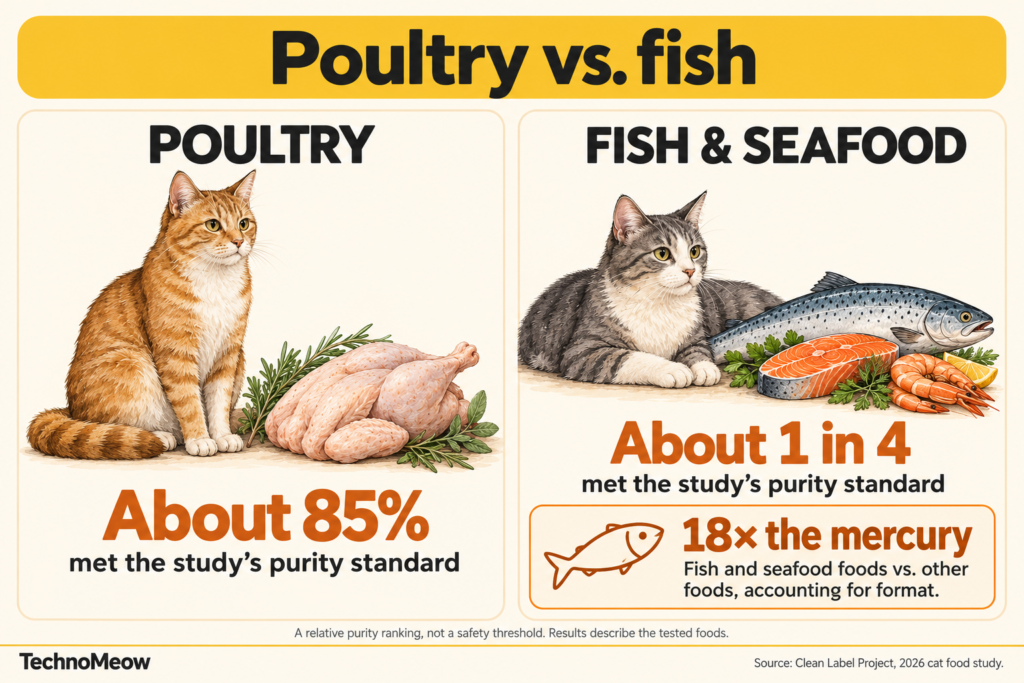
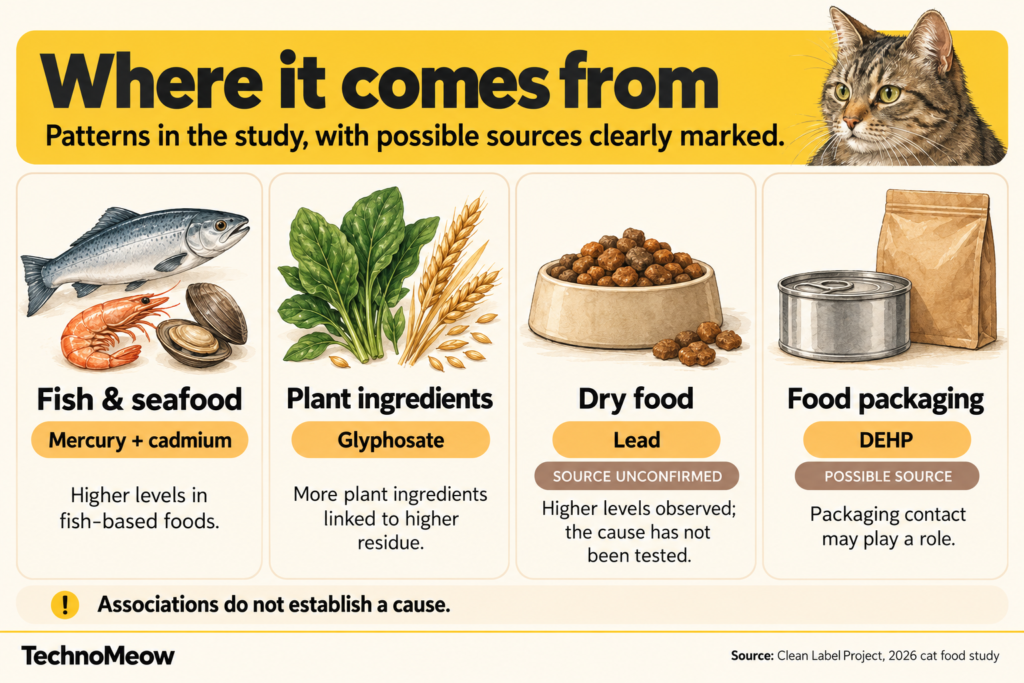
- Fish and seafood foods carried about 18 times the mercury of other foods, after accounting for wet versus dry.
- Among wet foods, the gap was about 28 times.
- Nearly half (48.6%) of fish and seafood products ranked among the highest for mercury. No poultry-based product did.
- Cadmium ran about 2.5 times higher in fish-based foods.
Mercury builds up in marine animals through the food chain, which is why the FDA also advises pregnant and breastfeeding women on choosing safer seafood. A cat can eat one seafood-based food every day for years.
Foods without fish in the name but with a marine ingredient on the label still tended to run higher in mercury than foods with no marine ingredients. Some fish-based foods did make the cleanest lists, and five foods across the two lists below contain fish or seafood.
Dry food carried about 3 times the lead
Dry food had roughly 3 times the lead of wet or air-dried food, and the gap held after accounting for protein. Lead wasn’t tied to any one protein, which suggests the format plays a role. Clean Label Project doesn’t claim to know why yet. It lists mineral premixes and growing soil as possible sources but hasn’t tested that.
More plant ingredients meant more herbicide residue
Glyphosate, a widely used herbicide, was detected in 37% of products, and its breakdown product AMPA in 12%. Foods with more plant ingredients in the first ten on the label had higher levels. Each additional plant ingredient went with about 40% more glyphosate, and the count mattered more than where the plants sat on the list.
The first ingredient doesn’t always tell the story
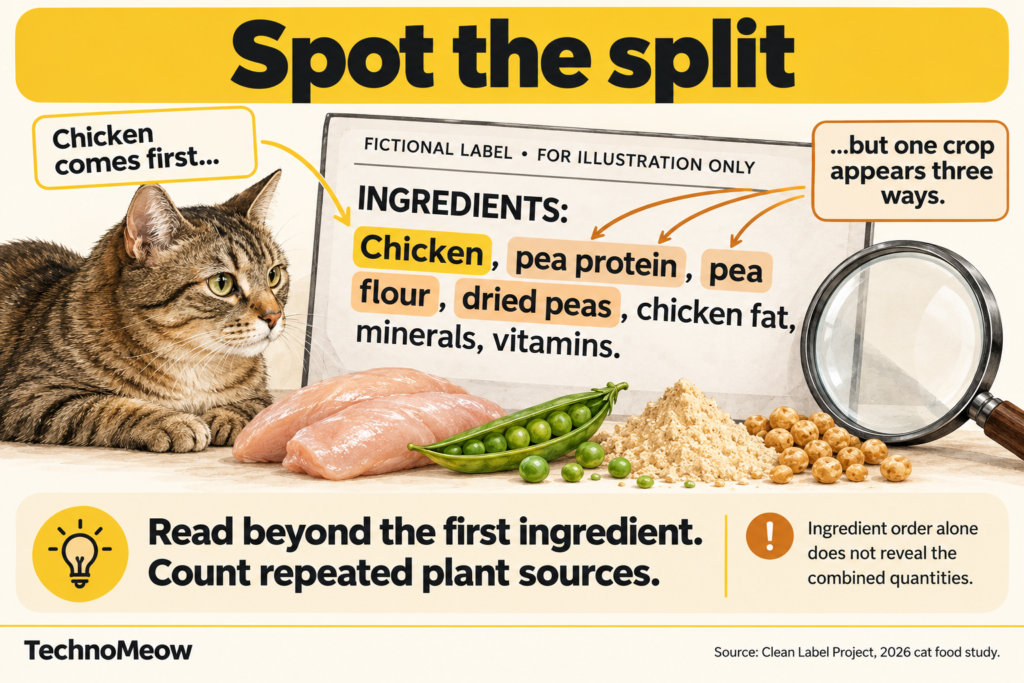
In 35 of the 100 foods, the first-listed ingredient was outnumbered by ingredients from another category within the top ten. Most often, meat or fish came first and the next nine were mostly plants, sometimes different forms of the same plant, like pea protein and pea flour. The industry calls this ingredient splitting. It’s allowed, and a single crop can legitimately appear several times because different parts do different jobs. It can also make the headline ingredient look more dominant than it is. Foods where plant ingredients outnumbered the named meat tended to carry more lead.
The pattern was nearly identical across formats: 35.5% of dry foods, 35.0% of wet foods and 35.7% of air-dried foods.
When Clean Label Project combined this study with earlier cat food testing (541 samples across 87 brands), herring meal, tuna and fish broth were the ingredients most strongly tied to contamination. Turmeric ranked fourth, which the group links to the spice’s documented history of lead adulteration.
Packaging chemicals showed up too
DEHP, a plasticizer linked to hormone disruption, was detected in 48 of 100 foods, more than any contaminant except the heavy metals. Detection rates were similar in dry and wet foods, but where DEHP was found, canned and pouched foods carried about 5 times as much as bagged foods. Clean Label Project suggests the difference may be related to food contact with packaging.
Bisphenols were rarely detected. BPA turned up in two products and BPS in one, which matches the move away from bisphenols in packaging that the group has seen in other categories.
Your Four-Metal Cheat Sheet
Clean Label Project doesn’t set a safe level for any of these. It argues “trace” shouldn’t be read as “safe,” because low levels can add up when a cat eats the same food for years. So this table shows what shifts the risk up or down and not a number to stay under.
A Few Things to Know First
- It ranks foods against each other. The results compare products and don’t show whether a specific food is enough to make a cat sick. Veterinary coverage from dvm360 described the health risks as unclear.
- Each food was tested once, and most brands had one product tested. Results can vary from batch to batch. Brand-level conclusions are limited to brands with at least three products in the study.
- The industry reads it differently. The Pet Food Institute, which represents manufacturers, told Local 12 that commercial cat food is made under controls that include ingredient specifications, supplier verification, testing and traceability.
- Clean Label Project also certifies brands. It runs a certification program that brands can join, and some brands in this report are certified. On its Clean Sixteen sheets, the group says the rankings rest solely on cumulative contamination scores, aren’t an endorsement of nutritional value and come with no sponsorship from the featured brands.
- Some news summaries compressed the details. A few said chicken foods carried more lead. The report ties lead to dry format and to plant-heavy ingredient lists, not to chicken.
The Full Clean Sixteen Lists
Clean Label Project published two lists, one for wet food and one for dry and freeze-dried food. They rank foods by cumulative contamination scores across six panels: heavy metals, phthalates, BPA and BPS, pesticides, glyphosate and acrylamide. The group says the lists aren’t an endorsement of nutritional value, so treat them as one input when you choose a food. Both are shown alphabetically by brand.
Wet Clean Sixteen (16 of 40 wet foods tested)
| # | Brand | Recipe | Protein | Format |
|---|---|---|---|---|
| 1 | Applaws | Chicken Breast & Duck in Broth | Poultry | Broth |
| 2 | Freshpet | Tender Chicken & Garden Vegetable Recipe | Poultry | Bites |
| 3 | Friskies | Salmon Dinner Pâté | Fish | Pâté |
| 4 | Instinct | Original Grain-Free Pâté | Poultry | Pâté |
| 5 | Nulo | Medal Series Chicken & Chicken Liver Recipe in Broth | Poultry | Broth |
| 6 | Nulo | Medal Series Chicken, Duck & Pumpkin Recipe in Broth | Poultry | Broth |
| 7 | Purina | Fancy Feast Grilled Turkey Feast in Gravy | Poultry | Gravy |
| 8 | Purina | Pro Plan White Meat Chicken & Vegetables Entree | Poultry | Entree |
| 9 | Reveal | Grain-Free Chicken Breast in Broth | Poultry | Broth |
| 10 | Reveal | Grain-Free Tuna Fillet in Broth | Fish | Broth |
| 11 | Sheba | Cuts in Gravy, Roasted Chicken Entree | Poultry | Gravy |
| 12 | Smalls | Smooth Bird Chicken Recipe | Poultry | Pâté |
| 13 | Tiki Cat | Chicken & Pumpkin Recipe in Broth | Poultry | Broth |
| 14 | Tiki Cat | Chicken, Pumpkin & Duck Recipe in Broth | Poultry | Broth |
| 15 | Tiki Cat | Chicken, Pumpkin & Lamb Recipe in Broth | Poultry & Lamb | Broth |
| 16 | Tiki Cat | Chicken, Pumpkin & Tuna Recipe in Broth | Poultry & Fish | Broth |
Dry and Freeze-Dried Clean Sixteen (16 of 60 dry, freeze-dried and air-dried foods tested)
| # | Brand | Recipe | Protein | Format |
|---|---|---|---|---|
| 1 | Bixbi | Rawbble Turkey Recipe | Poultry | Freeze-dried |
| 2 | Boss Cat | Complete & Balanced Boss Pork Recipe | Pork | Freeze-dried |
| 3 | Fresh Is Best | Freeze-Dried Cat Food, Chicken Recipe | Poultry | Freeze-dried |
| 4 | Green Juju | Duck & Sardine Recipe | Poultry & Fish | Freeze-dried |
| 5 | Hill’s | Science Diet Adult 1-6 Chicken Recipe | Poultry | Kibble |
| 6 | Kirkland Signature | Chicken & Rice | Poultry | Kibble |
| 7 | McLovin’s | Purrfect Poultry Recipe | Poultry | Freeze-dried |
| 8 | Natural Pet Food Group | New Zealand Chicken Feast | Poultry | Air-dried |
| 9 | Nulo | Freestyle Chicken & Salmon Recipe | Poultry & Fish | Freeze-dried |
| 10 | Purpose Pet Food | Carnivore Duck | Poultry | Freeze-dried |
| 11 | Smallbatch | Freeze-Dried Meal Bites, Turkey Recipe | Poultry | Freeze-dried |
| 12 | Stella & Chewy’s | Duck Duck Goose | Poultry | Freeze-dried |
| 13 | Stella & Chewy’s | Tummy Ticklin’ Turkey | Poultry | Freeze-dried |
| 14 | Vital Essentials | Rabbit Entree | Rabbit | Freeze-dried |
| 15 | Weruva | Paw Lickin’ Chicken | Poultry | Freeze-dried |
| 16 | Whole Life | Nature’s Remedy Recover Stomach Distress | Poultry | Freeze-dried |
Only two of the 16 are kibble, out of 31 kibbles tested: Hill’s and Kirkland Signature. The other 14 are freeze-dried or air-dried, which fits the finding that dry food carried about 3 times the lead of the other formats.
What Else Stands Out on the Lists
The lists hold a few patterns beyond the two brands I cover next.
- Supermarket brands made the wet list. Friskies, Purina (Fancy Feast and Pro Plan) and Sheba all have a food on it, so a clean result doesn’t have to come with a premium price.
- Fish isn’t automatically out. Three of the 16 wet foods contain fish: Friskies Salmon Dinner Pâté, Reveal Grain-Free Tuna Fillet and Tiki Cat Chicken, Pumpkin & Tuna. Fish foods did worst overall, but individual products can still land cleanly.
- Some brands show up more than once. Tiki Cat has four wet foods on the list, Nulo, Purina and Reveal have two each, and Stella & Chewy’s has two dry foods. That hints at consistent sourcing, but Clean Label Project only makes brand-level statements for brands with at least three products tested, so treat it as a hint.
Why Smalls and Freshpet Get Their Own Sections
I’ve given Smalls and Freshpet their own sections because our team has hands-on experience with both. Nikki fed Smalls to her five cats and Freshpet’s dog recipes to her dog. They’re also two of the three brands the report lists as Clean Label Project certified (Bixbi, on the dry list, is the third), so both have a relationship with the group that published these rankings. The other foods on the lists are just as much a part of the study, and everything above applies to them equally.
Where Smalls Landed
Smalls Smooth Bird, which Clean Label Project lists as the Smooth Bird Chicken Recipe, is one of the 16 foods on the group’s wet Clean Sixteen list, tagged as a poultry recipe.
I haven’t fed it to Milo. Smalls doesn’t ship to Canada, so that one is out of my hands. Our editor Nikki fed it to her cats, picky ones included, and her full Smalls review covers the recipes, textures and what it costs.
One practical link to the study: Clean Label Project’s advice for cats that eat a lot of fish is to rotate proteins, and Smalls lets you swap proteins and textures inside one plan. Fish recipes fall under the same finding as any fish-based food, which is higher on average with plenty of individual exceptions.
| Best For | Cat parents who want fresh, gently cooked food with flexible proteins and portions |
| Format | Gently cooked, frozen pâté |
| Key Proteins | Chicken in Smooth Bird. The wider line also includes turkey, pork, beef and fish. |
| Subscription? | Yes. Delivery plans can be adjusted or skipped. |
| Approx. Cost | Roughly $5 per 5 oz packet in retail listings, enough for a 10 lb cat for a day. Some recipes cost extra per packet. |
| Freezer Required | Yes. Needs freezer and fridge space. |
| Main Limitation | Premium price compared with canned or dry food. Not suitable for cats with advanced kidney disease. Not available in Canada. |
If your cat has kidney disease, talk to your vet before changing food. Smalls isn’t suitable for cats with advanced kidney disease, and that holds no matter where it landed on this list.
Big Pet Food prioritizes profits over cat health and they pack cat food with preservatives and fillers. Smalls believes cats deserve better and uses natural ingredients and added vitamins and minerals in our food. The fresh food come in many delicious flavors and textures.

Where Freshpet Landed
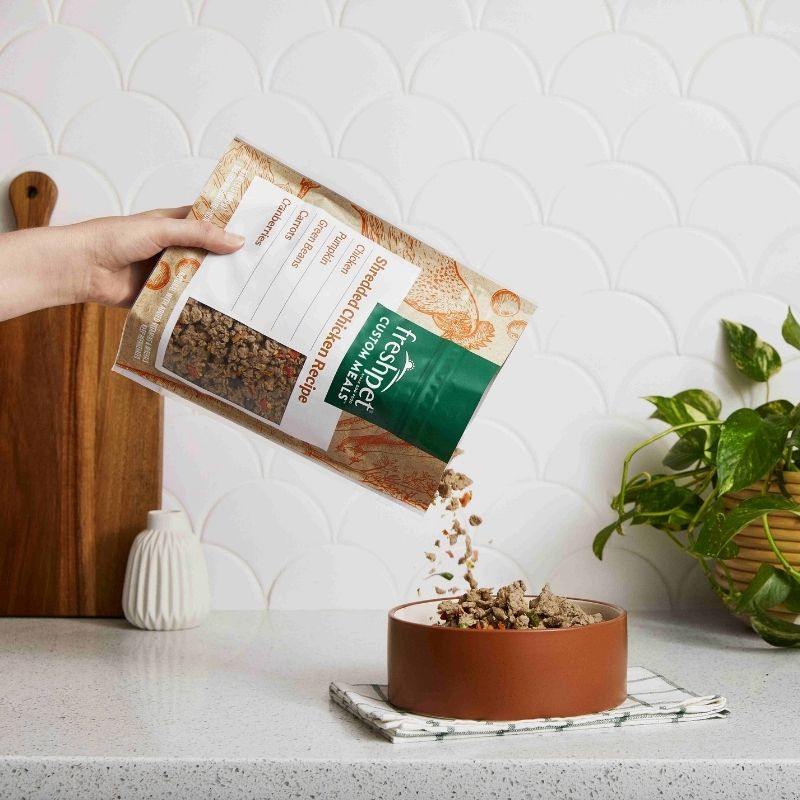
Freshpet is also on the wet Clean Sixteen list. Clean Label Project lists it as the Tender Chicken & Garden Vegetable Recipe, tagged as a poultry food.
As noted above, Freshpet is also a Clean Label Project certified brand. The result applies to the one recipe and batch that was tested, not to every Freshpet recipe.
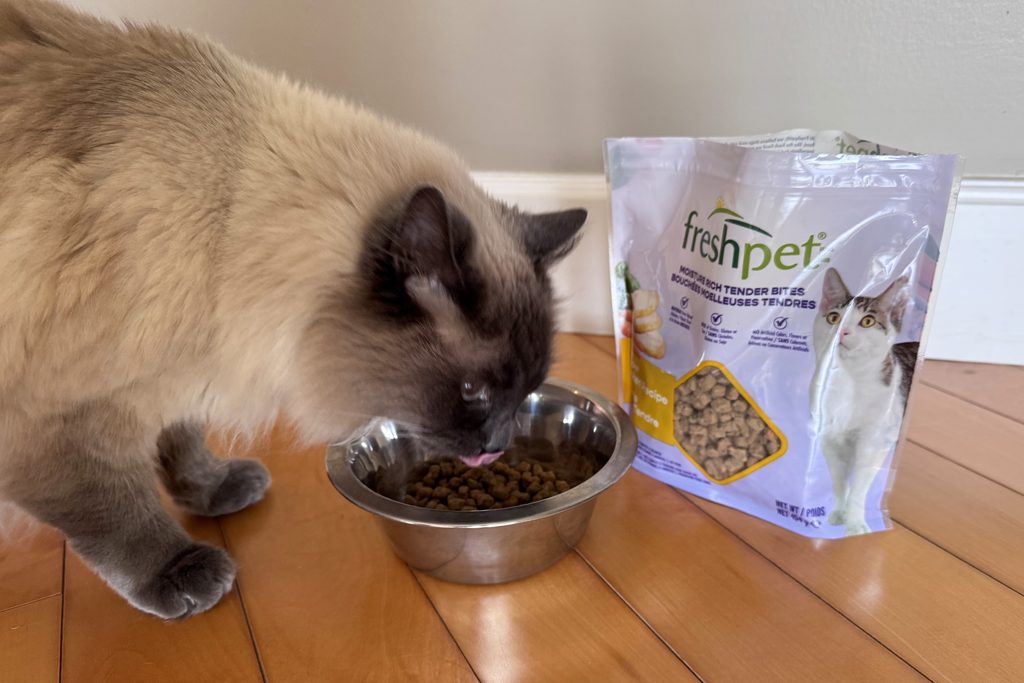
Milo recently started eating Freshpet Tender Bites, and he really enjoys it, which is saying a lot for my picky eater. It’s sold in the fridge case at my local grocery store. I also got the pâté, but we haven’t put it on the menu yet; more about that once he tries it.
Our editor Nikki fed Freshpet Delivery’s dog recipes to her dog Freya, and it’s the first food she rushed out to buy more of. Those recipes are made for the Delivery service, so that is a dog’s verdict and not a cat test.
Freshpet is sold refrigerated rather than frozen or shelf-stable, which makes it easy to try one recipe without signing up for a plan. It also gives you a poultry-based option for the rotation the study points toward.
| Best For | Cat parents who want refrigerated fresh food they can pick up at a store |
| Format | Fresh, refrigerated. Clean Label Project’s sheet lists it as bites. |
| Key Proteins | Chicken in the Tender Chicken & Garden Vegetable Recipe |
| Subscription? | No. Sold in refrigerated cases at retailers. Check availability near you. |
| Approx. Cost | Premium compared with canned or dry food. Confirm current pricing. |
| Storage | Keep refrigerated and follow the package use-by guidance. |
| Main Limitation | Premium price and fridge space. Results apply to the one recipe and batch tested. |
Freshpet Delivery takes a familiar fresh dog food brand and turns it into a much more personalized service. Instead of figuring out portions yourself, you get a meal plan and feeding guidelines based on your dog, with fresh, gently cooked food delivered right to your door.
BEST PRICE GUARANTEED
SAVE 55% OFF YOUR FIRST ORDER WITH FRESHPETPPA55
What I’d Actually Do as a Cat Parent
None of this calls for panic or a pantry purge. These are the changes that cost little and follow directly from the data.
- Read past the first ingredient. Look at the first ten and count the plants. Several forms of one crop add up.
- Rotate proteins if your cat eats mostly fish. Clean Label Project recommends it and says you don’t need to cut fish out.
- Lean toward wet or air-dried if lead is your main worry. Dry food carried about 3 times as much.
- Ask the brand one question. Do you test finished product for heavy metals or only the ingredients? A single test result only reflects one batch.
- Switch slowly. Mix the new food in over a week or two. Milo took about a month to accept a new litter box, so I never rush a change.
- Run it by your vet for seniors or kidney issues. Kidneys carry the long-term burden of metal accumulation, so check with your vet before changing food.
FAQ
Is my cat’s food unsafe if it isn’t on a Clean Sixteen list?
No. A food that isn’t on a Clean Sixteen list isn’t automatically unsafe, because the study ranks 100 foods against each other and doesn’t set a safety line.
- Only 100 foods from 62 brands were tested, so many products were never included.
- Each food came from a single batch.
- Clean Label Project says its results don’t show whether a specific food will harm a cat.
Should I stop feeding my cat fish-based food?
Not necessarily. Clean Label Project says rotating in other proteins may help if your cat eats a fish-based food exclusively, and that you don’t need to eliminate fish.
- Fish-based foods carried about 18 times the mercury of other foods.
- Some fish-based foods still met the study’s standard.
- For picky cats, a complete diet they will actually eat remains the priority.
Is wet food better than dry food for heavy metals?
It depends on the metal. Dry food carried about 3 times the lead of wet or air-dried food, but wet fish foods carried about 28 times the mercury of other wet foods.
- Dry and wet foods met the study’s overall standard at nearly the same rate, within one percentage point.
- Where DEHP was detected, canned and pouched foods carried about 5 times as much as bagged foods.
- Protein source was a stronger predictor than format.
Do kittens and senior cats need different food because of this?
The study didn’t test by life stage, so it can’t answer that.
- Clean Label Project notes that kidneys carry the long-term burden of metal accumulation and that chronic kidney disease is among the most common causes of death in older cats.
- Cats with kidney disease have specific dietary needs, so any food change should go through your vet.
How can I check what’s in my cat’s food?
Start with the ingredient list. Look for marine ingredients such as herring meal, tuna or fish broth, and count the plant ingredients in the first ten.
- Clean Label Project publishes the full list of tested products at cleanlabelproject.org.
- Ask the brand whether it tests finished product for heavy metals and not only the ingredients.
Do the Clean Sixteen lists show that a food is nutritionally complete?
No. Clean Label Project says its rankings are based solely on cumulative contamination scores and aren’t an endorsement of nutritional value or product claims.
- Look for the “complete and balanced” statement on the label.
- Check with your vet if your cat has a medical condition.
Final Thoughts
Cats tend to eat the same food for years, which is why small differences in contaminants can add up and why this study got so much attention. It’s also a ranking of 100 foods from one nonprofit, with one batch each, so I’d treat it as a good reason to read labels and not a reason to panic.
Read the first ten ingredients, rotate when you can and ask your brand how it tests. That covers most of what the data supports.




Leave a Comment