

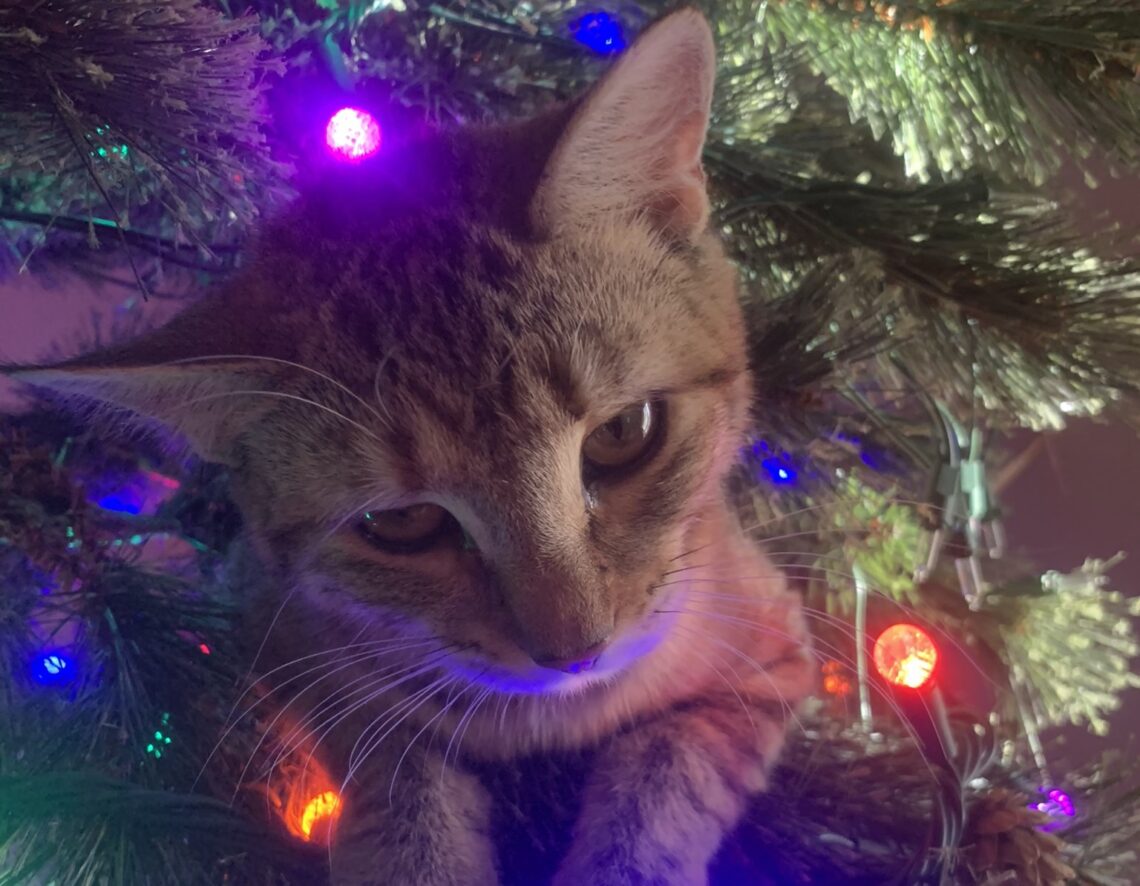
How do you keep a cat from attacking your Christmas tree? Don’t get a Christmas tree. 😀 Seriously, that’s about the only foolproof method I’ve found. Because here’s the thing. You can buy all the cat deterrents in the world, put up barriers, and lecture your cat about respecting other people’s property (good luck with that last one). But at the end of the day, you’ve brought a giant tree into your living room. A tree! With branches! And dangling toys! And possibly even twinkling lights!
You basically built your cat an indoor amusement park and then told them they weren’t allowed to use it.
Now, some cats are perfectly content to admire the Christmas tree from a distance. Others see it as a personal challenge. And if you have multiple cats, there’s a decent chance at least one of them falls into that second category.
I have six cats, so I’ve learned a thing or two about keeping Christmas trees upright and relatively intact. I’ve also learned to lower my expectations regarding what constitutes a beautifully decorated tree.
If you’d like to enjoy a Christmas tree without spending the entire holiday season worrying about your cats destroying it (or hurting themselves in the process), here are some practical ways to keep everyone safe.
1. Start With a Shorter, Sturdier Christmas Tree
I know those gorgeous, towering Christmas trees look amazing in holiday photos. But when you have cats, bigger isn’t necessarily better. A tall, narrow tree has a higher center of gravity, making it easier to tip over when a determined cat decides to climb it.
Believe me, determination is something my cats have in abundance. We use a shorter tree (like 6 feet max) with a wider base. It’s not quite as impressive as an 8-foot tree stretching to the ceiling, but it’s a lot more stable.
When choosing a cat-friendly Christmas tree, look for:
- A shorter height, especially if your cats are enthusiastic climbers.
- A wide, sturdy stand that won’t wobble easily.
- A relatively lightweight tree, particularly if you’re going with an artificial one.
- A design with strong branches that won’t easily bend or break.
If you’re buying an artificial tree, pay attention to how securely the sections connect. You don’t want the top half coming loose because your cat decided to investigate the view from up there. Also, don’t assume that a small tabletop tree is automatically safer. A lightweight tree sitting on a table can be surprisingly easy to knock over. Plus, you’ve just given your cat another reason to climb onto the furniture.
You don’t have to get anything expensive, either. Until my cats get past the “destroy all things holiday-related” phase, I’m just using a cheap tree. When they outgrow their insanity (which hopefully they will, all of my other cats have), I’ll get something I love. This one below is pretty cool since it comes with a cat cave.
2-in-1 Tree for Cat Lovers: 6FT artificial Christmas tree comes with a plush cat tunnel ring around the base. Cats get a cozy hideaway, play tunnel and nap spot, while the ring works as a tree skirt to keep paws off the trunk and stand

2. Anchor Your Christmas Tree to the Wall (In Two Places!)
This is probably my single biggest Christmas tree safety recommendation. Anchor that baby to the wall. And not just in one place. We secure ours in two places for extra stability.
A Christmas tree might feel perfectly sturdy when you give it a little shake, but that doesn’t mean it can withstand a cat launching themselves into the branches at full speed.
Especially when the cat in question has absolutely no concern for the laws of physics.
You can use furniture safety straps, sturdy cord, or other anchoring hardware to secure the tree to wall studs or properly rated anchors. We just use strong twine. Ideally, attach the supports at different points to help prevent the tree from tipping or twisting.
Make sure everything is firmly attached and that there aren’t any loose loops or dangling cords your cats could get tangled in.
One important thing: Anchoring your tree doesn’t mean it’s suddenly safe for your cat to climb. It’s a backup safety measure, not an invitation to turn the Christmas tree into a jungle gym.
But if your cat does make a questionable decision (and let’s face it, that’s practically a holiday tradition), you’ll have a much better chance of keeping the whole thing upright.
3. Switch to Shatterproof, Toddler-Safe Ornaments
My Christmas tree the last couple of years (I’ve adopted kittens in 2023, 2024, and earlier in 2026) my tree has been covered in Cookie Monster, Cars, and…well, anything that was popular in like 2005 with a 2-year-old.
When my son was a toddler, I bought ornaments that could survive being dropped, grabbed, and generally treated like toys. Turns out, they work pretty well for cats, too.
They’re not exactly the sophisticated Christmas aesthetic I once envisioned for my adult life, but they’ve earned their place on my tree.
Glass ornaments are especially risky because they can shatter into sharp pieces. A broken ornament can cut your cat’s paws or mouth, and swallowing pieces can cause serious injuries.
Instead, look for ornaments made from durable, nonbreakable materials. Plastic, fabric, and other sturdy decorations are generally better choices than glass, although you still need to watch for small pieces, loose embellishments, or anything your cat might chew off and swallow. A shatterproof ornament isn’t necessarily chew-proof.
Honestly, if you have to choose between a gorgeous heirloom ornament and a plastic Spider-Man that’s survived 20 Christmases, Spider-Man might be the smarter investment. At least until your cats develop better manners. (I’m not holding my breath.)
If you want to really lean into the whole “cat-centric Christmas tree” vibe, these ornaments are adorable. Although they’re also probably really tempting for your cat to steal.
These kitten Christmas ornaments are made of felt material, which is soft and sturdy enough for you to use, they can keep bright colors and shapes for a long time, light in weight and easy to carry around, which can accompany you throughout the whole Christmas

4. Keep the Most Tempting Decorations Near the Top
Cats are naturally attracted to things that dangle, swing, sparkle, or move. Which pretty much describes every Christmas ornament ever invented.
If you hang a shiny ornament from the lowest branch, right at cat-eye level, don’t be surprised when your cat starts batting at it. From their perspective, you’ve thoughtfully provided a new toy.
One easy way to reduce temptation is to keep ornaments off the lowest branches entirely. Put your sturdier, less interesting decorations toward the bottom and save anything particularly appealing for higher up.
Of course, this only works to a point. If your cat is a dedicated climber, the top of the tree is not exactly inaccessible territory.
But keeping the bottom branches relatively bare can help discourage casual ornament theft, especially from cats who prefer batting at decorations rather than climbing the whole tree.
And if you have a cat who simply cannot resist a particular ornament, just remove it. There’s no rule that says your Christmas tree has to win a decorating contest.
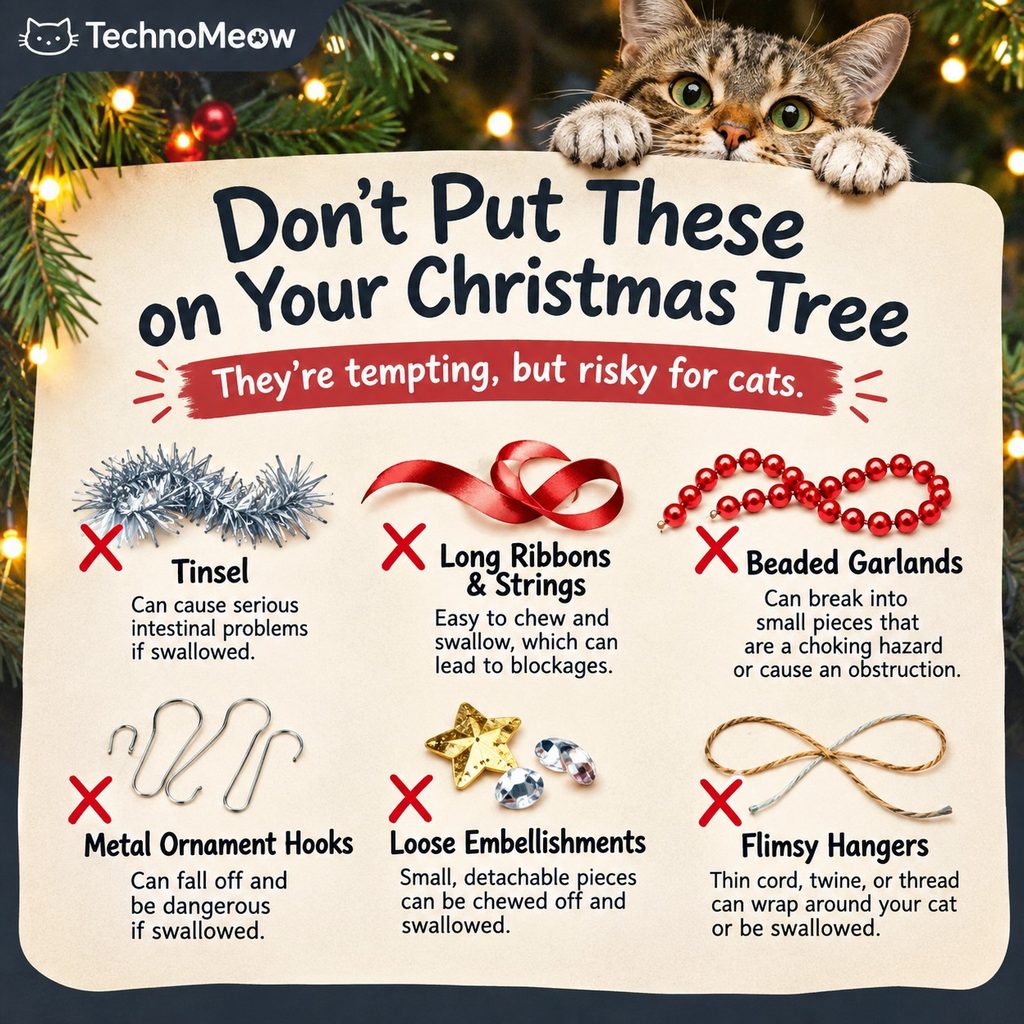
5. Skip the Tinsel, Ribbon Garlands, and Dangling Strings
I know. Tinsel looks pretty. Unfortunately, it also looks like an irresistible toy to many cats. And unlike a plastic ornament that gets knocked across the floor, tinsel can become extremely dangerous if swallowed.
Long, thin materials like tinsel, curling ribbon, and string can cause what’s called a linear foreign body. Essentially, part of the material can get caught inside your cat’s digestive tract while the rest continues moving through the intestines.
That can lead to serious intestinal damage and potentially life-threatening complications. So my advice is simple: Skip the tinsel altogether.
I’d also avoid long strands of ribbon, beaded garlands that can break apart, and anything else that could become a swallowing hazard.
If you want a little extra sparkle, choose decorations that are securely attached and don’t have long, loose strands.
And if you ever see a piece of string or tinsel hanging from your cat’s mouth or rear end, don’t pull it. Contact your veterinarian immediately. That’s one Christmas decoration you definitely don’t want to retrieve yourself.
6. Be Smart About Christmas Tree Lights
Christmas lights are one of my favorite parts of decorating. Unfortunately, electrical cords are also fascinating to certain cats, especially kittens who are still in their chew-everything phase.
And I happen to have two kittens right now, so this is particularly relevant in my house. Chewing through an electrical cord can cause burns, electric shock, or worse.
To reduce the risk, use lights and cords that are in good condition, keep electrical connections out of reach, and consider protective cord covers where necessary.
Battery-operated lights can eliminate some electrical hazards, but they aren’t automatically safe. Battery compartments need to be securely closed, and any loose batteries must stay well away from curious cats.
A few other precautions worth taking:
- Unplug the tree lights whenever you’re asleep or away from home.
- Avoid leaving loose cords dangling from the branches.
- Check regularly for bite marks or damaged wires.
- Keep extension cords and power strips inaccessible to your cats.
- Consider lights with fewer exposed wires, but don’t assume pre-lit trees are chew-proof.
And don’t count on your cat growing out of chewing cords. Some do. Others apparently consider electrical wiring a lifelong hobby.
I like these because they don’t get super-hot and the cords are fairly thick. They’re very similar to the ones I use on my tree.
Operating at a low voltage of 29V, these outdoor Christmas lights are safe to touch and don't overheat with prolonged usage. The outdoor Christmas string lights are made of high-quality material, and with an IP44 waterproof rating, they are suitable for both indoor and outdoor use.

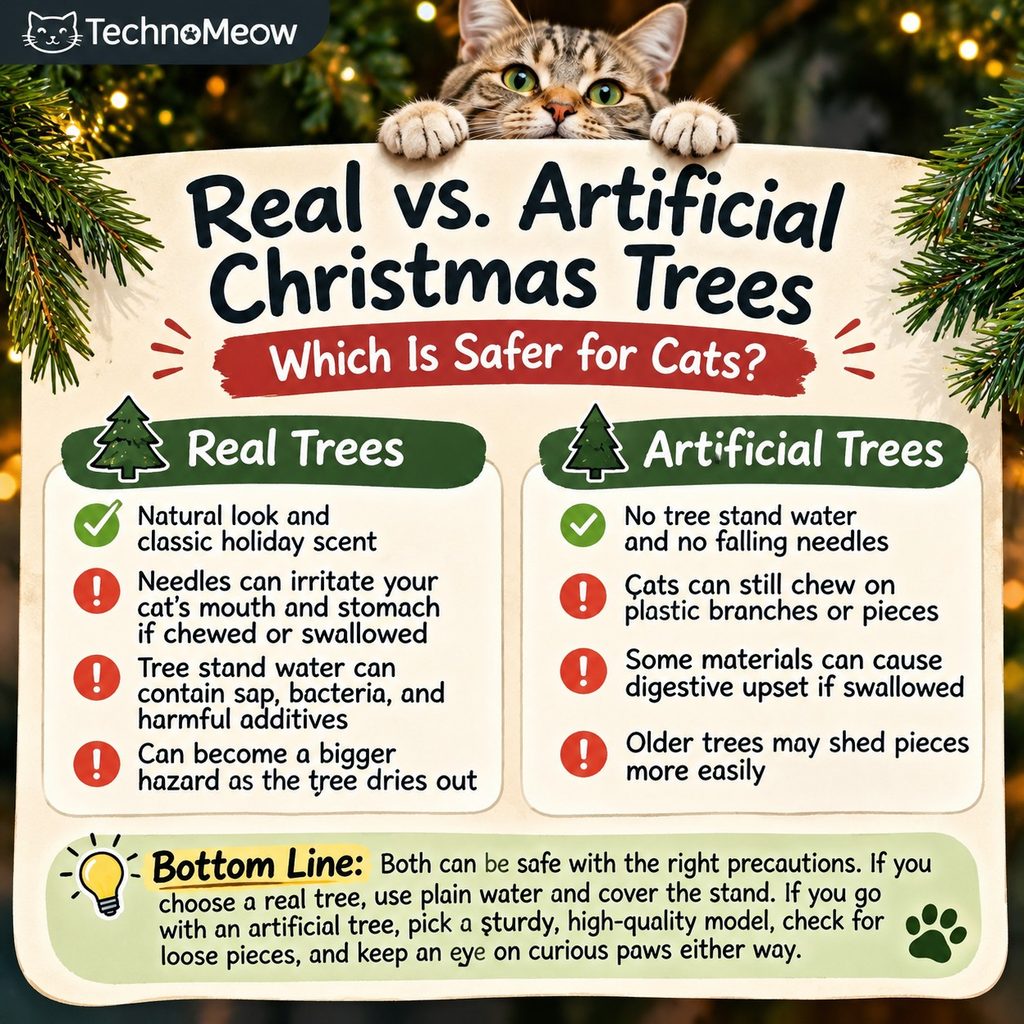
7. Artificial or Real Christmas Tree: Which Is Safer for Cats?
This is one of those questions without a perfect answer. Both real and artificial Christmas trees have potential hazards, and neither is completely cat-proof.
Real Christmas Trees
Real trees smell wonderful, but they introduce a few additional concerns. Pine, fir, and spruce needles can irritate your cat’s mouth and digestive system if chewed or swallowed. Sharp needles may also cause injuries.
The water in the tree stand is another concern. It can collect sap, bacteria, and debris, and added preservatives or fertilizers may introduce additional risks.
If you choose a real tree, cover the water reservoir so your cats can’t drink from it. Use plain water rather than chemical additives, and clean up fallen needles regularly.
You’ll also want to keep an eye on how dry the tree becomes, since dried-out branches and needles create additional hazards.
Artificial Christmas Trees
Artificial trees eliminate the need for a water reservoir and don’t drop natural pine needles. However, cats can still chew on plastic needles, wires, or other parts of the tree.
Swallowing artificial tree material can cause digestive irritation or an obstruction, depending on the amount and type. Plus, older artificial trees may shed pieces more easily than newer ones.
Personally, I prefer an artificial tree because it’s easier to manage with multiple cats. But that doesn’t mean I can just put it up and forget about it.
The cats would certainly appreciate that approach. I would not appreciate the results.
8. Give Your Cats Something Better to Climb
Here’s something that sounds almost too obvious, but it’s worth mentioning. If your cat loves climbing your Christmas tree, make sure they have other appropriate places to climb.
A sturdy cat tree, wall-mounted climbing shelves, or a window perch can give your cat somewhere to explore without putting your Christmas decorations at risk.
Of course, there’s a slight problem with this strategy. Your cat may already have three perfectly good cat trees, multiple scratching posts, and an entire house full of comfortable places to hang out.
And they’ll still choose the Christmas tree. Because it’s new. And it’s forbidden. And apparently those two qualities make something infinitely more interesting.
Still, offering alternative climbing spots can help, especially if you make them more appealing with toys, treats, or a good view out the window.
Try placing a favorite cat tree in the same room as your Christmas tree, but far enough away that your cat can’t use it as a launching platform. We don’t need to make their job easier.
For your cat, the sky’s the limit with this 76-inch, XXL heavy-duty cat tree, from Frisco by Chewy! With plenty of landing space, two roomy condos, one cozy hammock, sisal posts, and an extra-large perch, there’s simply so much for your cat to love! This heavy-duty cat tree is designed for your cat to climb, play, nap, and scratch just the way they like, as much as they like. There’s even a fun rope toy to make playtime a little more exciting!

9. Let Your Cats Investigate Before You Decorate
One trick that may help is putting up your Christmas tree a day or two before adding the decorations.
This gives your cats a chance to investigate the new addition without all the dangling ornaments and lights making it even more exciting. They can sniff it, circle it, and generally conduct whatever inspections they feel are necessary.
Some cats lose interest once the novelty wears off. Others won’t. But at least you’ll get a better idea of how your cats react to the tree before you spend an hour carefully arranging decorations.
Make sure the undecorated tree is already securely anchored, though. An undecorated tree can still tip over. You can also reward your cats for calm behavior around the tree.
If they’re sitting nearby without attempting to dismantle it, offer a treat or some attention. You’re not necessarily teaching them that the tree is completely off-limits. You’re teaching them that leaving it alone has its advantages.
Whether they decide those advantages outweigh the entertainment value of attacking Spider-Man is another matter.
10. Be Careful With Cat Deterrents
If you’ve spent any time searching for ways to keep cats out of Christmas trees, you’ve probably encountered some interesting suggestions.
Spray the tree with citrus. Cover the base with aluminum foil. Use essential oils. Put something noisy near the branches. Some of these methods may discourage certain cats, but others can introduce new hazards.
I would avoid using essential oils as Christmas tree deterrents. Many essential oils can be toxic to cats, particularly when ingested or when concentrated oils come into contact with their skin or fur.
Citrus peels and sprays aren’t necessarily harmless, either, especially if your cat chews or licks them.
Aluminum foil might discourage some cats from approaching the tree, but others will simply play with it. Torn or swallowed pieces can become a problem.
And please don’t spray your cat with water every time they approach the tree. Aside from being unpleasant, punishment can increase stress without teaching your cat what you actually want them to do.
Instead, focus on making the tree less tempting and providing safe alternatives. If you need a physical barrier, you could try a pet fence. Honestly, my cats would jump right over it. If you go that route, get something that you can use for other purposes. We have this one that we’ve used for my dog and also as a garden fence.
Includes 8 connected panels with thumb clips for connecting the ends together; 2 locking slide-bolt door latches; 8 ground anchors for secure placement outdoors; made of durable iron wire with a rustproof finish.

11. Watch Out for Other Holiday Decorations, Too
Your Christmas tree might be the main attraction, but it’s not the only holiday decoration that can cause trouble.
A few things deserve special attention.
- Lilies: These are extremely toxic to cats. Even small exposures to true lilies and daylilies, including pollen or vase water, can cause life-threatening kidney damage. I wouldn’t bring them into a home with cats at all.
- Mistletoe and holly: Both can be toxic if eaten. Keep them out of reach or choose artificial alternatives that don’t have small detachable pieces.
- Poinsettias: These have a much scarier reputation than they generally deserve. They’re usually only mildly toxic, but chewing them can still cause mouth irritation, drooling, or stomach upset.
- Candles: Open flames and curious cats are not a combination I’d recommend. Flameless candles are a much better option, provided their batteries are securely enclosed.
- Snow globes: Some contain liquids that are dangerous if swallowed, and glass globes can break. Keep them somewhere your cats can’t knock them over.
And remember that gift-wrapping supplies can be just as tempting as tree decorations. Ribbon, bows, string, and small plastic pieces should be cleaned up promptly.
There’s nothing quite like spending Christmas morning trying to figure out which cat stole the curling ribbon off a present.
12. Know When to Keep Your Cat Away From the Tree Entirely
Sometimes, despite your best efforts, a cat simply cannot be trusted around a Christmas tree. Maybe they’re obsessed with chewing the branches. Maybe they climb it constantly. Maybe they’ve already demonstrated that no ornament is safe from their paws.
In those cases, the safest solution may be keeping the tree in a room your cat can’t access without supervision. I know that’s not always practical, especially in smaller homes or open floor plans.
But if your cat is repeatedly engaging in dangerous behavior, restricting access is better than hoping they’ll eventually lose interest.
You can also consider alternative Christmas tree setups, like a securely mounted wall tree or a small tree displayed in a room that stays closed.
The goal isn’t to win a battle of wills with your cat. Because, frankly, that’s a battle you’re probably going to lose.
The goal is to enjoy the holidays without an emergency vet visit or a Christmas tree lying sideways across your living room.
What If Your Cat Still Won’t Leave the Christmas Tree Alone?
First, accept that some level of curiosity is normal. Your cat isn’t being bad. They’re being a cat. You’ve introduced a giant, unfamiliar object into their territory, covered it in interesting things, and then expected them to ignore it. That’s a pretty big ask.
If your cat keeps approaching the tree, redirect their attention toward something appropriate, like an interactive toy or a favorite scratching post. Reward them when they choose those alternatives.
And be consistent. If climbing the tree is off-limits on Monday, it should still be off-limits on Friday. But don’t expect perfection.
Some cats will eventually get bored with the tree. Others will spend the entire holiday season plotting their next attack.
The important thing is making sure the tree is secure, the decorations are safe, and your cat can’t easily get into something dangerous.
And if your cat suddenly starts vomiting, drooling excessively, refusing food, acting lethargic, or showing signs of pain after chewing on decorations, contact your veterinarian. Suspected electrical injuries, swallowed string, or exposure to lilies require immediate veterinary attention, even if your cat initially seems fine.
A Cat-Safe Christmas Tree Doesn’t Have to Be a Boring One
I’ll admit that my Christmas tree looks a little different than it did before I had cats. I didn’t exactly plan on decorating my Christmas tree with the same ornaments for more than two decades, but here we are.
And with six cats in the house, I’m not particularly interested in testing whether my nice glass ornaments can survive a fall.
The bottom line is that you don’t have to give up having a Christmas tree just because you have cats. You just need to make a few adjustments, secure everything properly, and accept that your cats may have some opinions about your decorating choices.
Will they still occasionally bat at an ornament? Probably. Will someone decide that sleeping underneath the tree is their new favorite hobby? Almost certainly. And will at least one cat look you directly in the eye while knocking off your favorite ornament? You betcha! That’s cats for you!
FAQs About Cats and Christmas Trees
How do I stop my cat from climbing the Christmas tree?
Start by anchoring the tree securely and providing alternative climbing spots, like a sturdy cat tree or shelves. Reward your cat for choosing those alternatives and redirect them when they approach the Christmas tree. If they continue climbing it, consider restricting access when you can’t supervise.
Are artificial Christmas trees safe for cats?
Artificial Christmas trees are generally a practical option for cat households, but they’re not completely risk-free. Cats can chew or swallow plastic needles, damage electrical cords, or knock the tree over. Choose a sturdy tree, anchor it securely, and monitor your cat’s behavior.
What can I spray on my Christmas tree to keep cats away?
I’d skip homemade sprays containing essential oils, citrus oils, or other potentially irritating ingredients. Some can be harmful to cats, especially if licked or ingested. Physical barriers, safe decorating choices, and positive reinforcement are better starting points.
Why is my cat obsessed with the Christmas tree?
Christmas trees offer many things cats naturally find interesting: new smells, climbing opportunities, hiding spots, and dangling objects that resemble toys. The novelty alone can make a tree irresistible, particularly to curious kittens.
Can cats get sick from drinking Christmas tree water?
Yes. Tree stand water can contain bacteria, sap, debris, and potentially harmful additives such as preservatives or fertilizers. Keep the water reservoir securely covered and use plain water. If your cat drinks treated tree water or develops symptoms, contact your veterinarian.
Should I leave my Christmas tree lights on overnight if I have cats?
It’s safer to unplug your Christmas tree lights when you’re sleeping or away from home. This reduces the risk of electrical injuries if your cat chews a wire and also helps prevent electrical fires.
Is a smaller Christmas tree better for cats?
A shorter tree with a wide, stable base can be easier to secure and less likely to cause serious damage if knocked over. However, even small trees need to be anchored or otherwise secured, especially if your cat likes climbing or batting at ornaments.







Leave a Comment