
Ask the internet how much Smalls cat food costs and you’ll get three answers from three different years. Half the review sites are still quoting a trial price Smalls retired, and the monthly estimates swing $80 apart depending on who you ask. So I skipped the recycled numbers and ran the live quiz myself: more than ten times in August 2026, every checkout total recorded, with different cats each run. One answer changes your price. The rest, as it turns out, is theater.
This article covers the real 2026 numbers, the box tricks that cut your bill by up to 30% and a calculator that does the subscription math for you.
Start Here: How Much Does a Smalls Subscription Actually Cost?
Pick your cat's size, add more cats if you have them, choose your protein situation and how you plan to feed. The tool hands back your real monthly range, plus the box setup that gets you the cheapest per-packet price. No email gate, no countdown timer, just the number Smalls will eventually charge you.
Then keep reading, because the sections below cover the parts the checkout page skips: the one quiz answer that raises your price, the freezer trick worth about $45 a month and why the sampler math falls apart the moment you have two cats.
READ OUR FULL REVIEW: Smalls Cat Food Review: Fresh, Flexible, and Totally Worth the Hype
How Much Does Smalls Cat Food Cost in 2026?
The short answer: Smalls cat food runs $105 to $150 a month for the average cat, fresh, human-grade, and delivered on a subscription, with a $25 to $26.50 sampler to start. The long answer is the rest of this article, because where you land inside that range is mostly up to you.
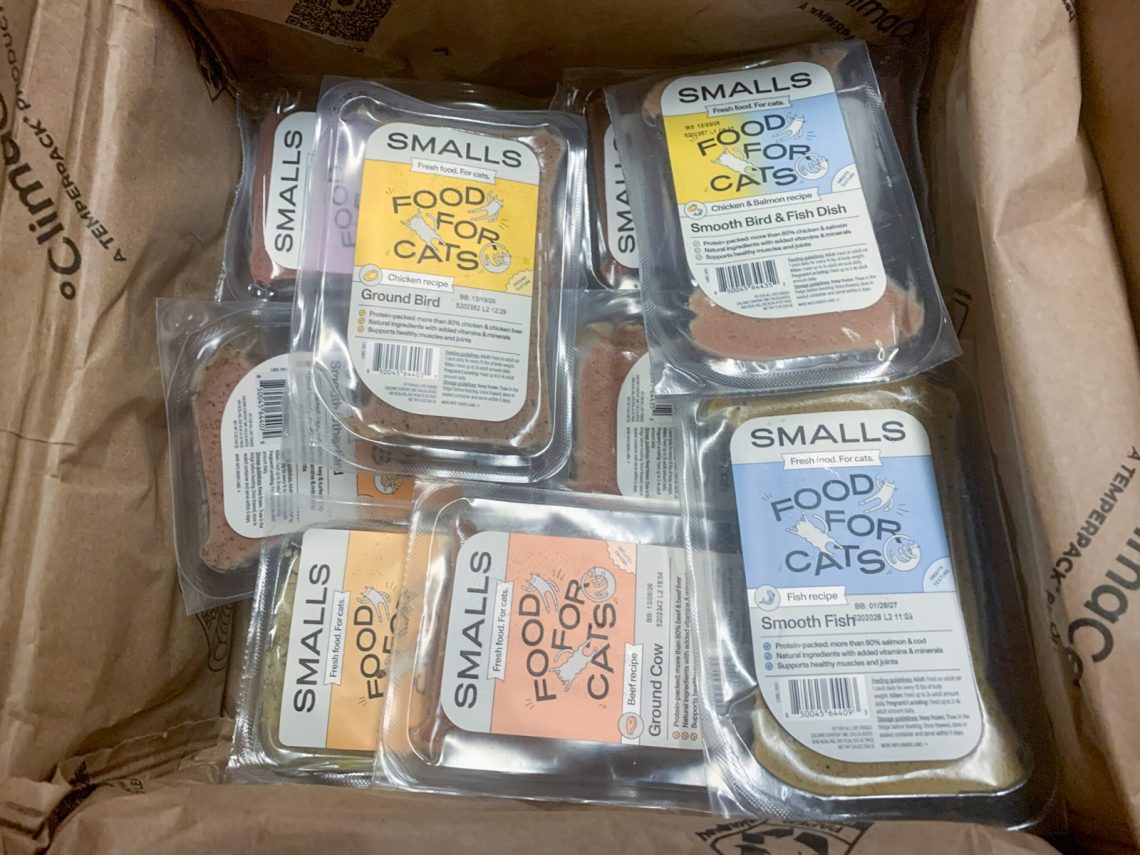
The Sampler Pack: let's start with the box everyone meets first. The sampler is 10 packets at a $50 base price, with 50% off your first order and free shipping. At checkout, that came to $25 to $26.50 across my runs, depending on how many premium recipes landed in the mix (more on that in a minute).
Quick heads-up if you've been researching: a lot of review sites still describe a $32 trial with 28 meals and 25% off. That trial is gone. Smalls restructured it, and most of the internet hasn't noticed. Every number in this article comes from live quiz runs in August 2026.
After the sampler, the math is refreshingly simple. Packets run $5.00 each ($5.50 for premium recipes), and each packet holds about 200 calories, which is roughly a full day of food for the average cat. Petite cats eat a little less than a packet a day, big cats closer to a packet and a half, and Smalls sorts the exact portions after checkout through their feeding guide.
Here's what that means in real dollars, from the smallest box at full price down to the biggest box at the maximum bulk discount:
| Cat size | Packets per day | Weekly cost | Monthly cost |
|---|---|---|---|
| Petite (smaller frame) | about 0.8 | $20 to $28 | $84 to $120 |
| Average (most cats) | about 1 | $25 to $35 | $105 to $150 |
| Big cat (large frame) | about 1.4 | $34 to $49 | $147 to $210 |
| Two average cats | about 2 | $49 to $70 | $210 to $300 |
That range isn't a guess. I built it from Smalls' own portioning numbers; it matches their published estimate for an average cat exactly, and it lines up with what real subscribers report paying (around $125 a month is the most common figure for an average cat). Notice how wide each range is, too. Where you land inside it depends entirely on decisions you make at the box level, not anything in the quiz.
What's Actually in the Smalls Sampler
Every sampler is built from the same parts, no matter what you told the quiz:
- 10 packets of fresh food (5 oz each), auto-selected for you. You can swap any of them in the sampler editor before checkout.
- 1 free bag of Bird Nip treats (crunchy chicken and catnip), billed as "free for life."
- $50 to $53 list price depending on the premium mix, landing at $25 to $26.50 after the 50% first-box discount, with free shipping.
Here's the default recipe spread from the all-proteins answer, the most common result. This exact 2/2/2/1/1/1/1 mix reproduced identically across every all-proteins run I made, regardless of cat profile or cat count.
| Recipe | Qty | Tier |
|---|---|---|
| Fresh Ground Bird (minced chicken) | 2 | Fresh |
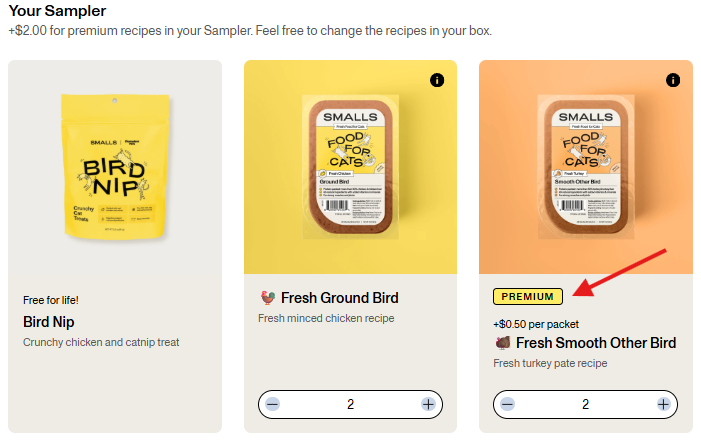
| Fresh Smooth Other Bird (turkey pâté) | 2 | Premium (+$0.50) |
| Fresh Smooth Pig (pork pâté) | 2 | Fresh |
| Fresh Smooth Bird & Fish (chicken + salmon pâté) | 1 | Fresh |
| Fresh Ground Other Bird (minced turkey) | 1 | Premium (+$0.50) |
| Fresh Smooth Bird (chicken pâté) | 1 | Fresh |
| Fresh Smooth Fish (salmon + cod pâté) | 1 | Premium (+$0.50) |
That works out to 6 fresh and 4 premium packets across 8 recipe types and 4 proteins: chicken, turkey, pork and fish. Runway-wise, at about 200 calories per packet, the box covers roughly 12 days for a petite cat, 10 days for an average cat, about a week for a big cat and 3 to 4 days for a typical two-cat household. More on that last squeeze below.
One quiet detail worth noticing: the default box tests two textures, smooth pâté and ground mince, across those proteins. Texture rejection is one of the biggest reasons cats refuse a new food, so the spread is quietly running a texture test alongside the protein test. It’s arguably the most genuinely useful "personalization" in the entire funnel, and it happens after the quiz, in a box everyone gets anyway.
The One Quiz Answer That Changes Your Price
I ran the quiz more than ten times with wildly different answers. One cat with every medical condition checked. One with none. Picky eaters, kibble loyalists, cats who allegedly want "more energy." Every single profile received the identical 10-packet sampler at the identical base price.
The only lever is the protein question. Chicken recipes are the cheap backbone of the Smalls catalog, so the more you restrict away from chicken, the more premium recipes (at +$0.50 per packet) get pulled into your box. Selecting all proteins added $2 to my sampler. Excluding chicken entirely added $3 and flipped the box to mostly premium.
Here's the full scoreboard from my runs.
Changes your price: Protein preference. Restricting away from chicken pulls premium recipes into the box at $0.50 extra per packet.
Changes nothing but the messaging:
- Name, sex, age and neuter status. Same box, same price.
- Body condition. All three answers produce the identical sampler.
- Pickiness and current food. Kibble loyalist or fresh convert, no difference.
- All 12 medical conditions. Even checked simultaneously, only the on-screen warnings change.
- Desired benefit. "More energy" costs exactly the same as nothing at all.
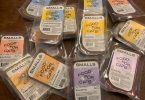
Fifty cents a packet sounds like nothing. At a typical subscription cadence, it quietly approaches $100 or more per year. The fix is simple: after the quiz, open the sampler editor and swap premium recipes (see image below, they're badged) for standard ones. Chicken-forward boxes are the cheapest path through Smalls, full stop.
One Warning: Don't Use the Protein Question as an Allergy Filter
This is the part that genuinely surprised me, so I tested it twice. I excluded chicken from a run, and the box that came back included a chicken and salmon recipe. Twice over. On a stricter run allowing only pig and fish, the same chicken-containing recipe showed up three times, meaning 30% of the box violated the exclusion I'd just set.
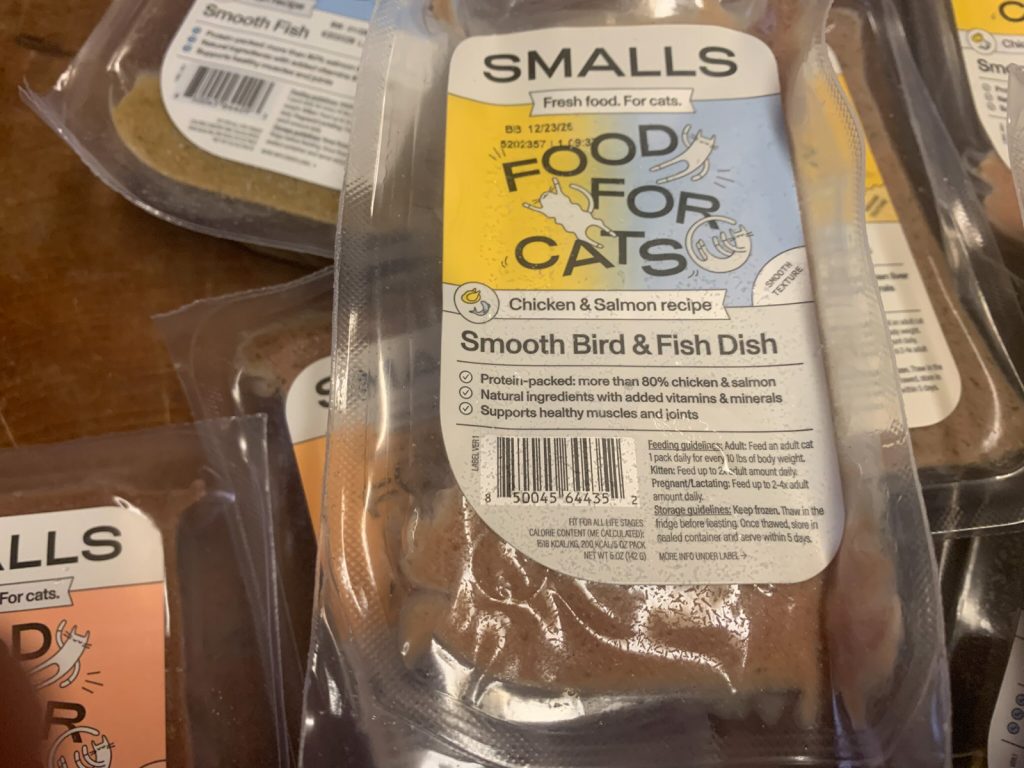
It's not a glitch. When your restrictions leave too few compliant recipes in the catalog, the quiz fills the 10-packet variety requirement with the nearest non-compliant option instead of shipping you a smaller-variety box. Multi-protein recipes like Bird & Fish Dish are the ones that slip through.
If your cat has a protein allergy or sensitivity, check every recipe’s ingredient list in the sampler editor before checkout and remove anything that leaked in. The quiz will not do this for you, and nothing in the flow warns you it won’t.
PRO TIP! The Bulk Secret That Will Save You Money
Here's the part of Smalls pricing nobody frames properly. That monthly range in the table above isn't random. The high end is the smallest box shipped frequently. The low end is the biggest box shipped slowly. Same food, same cat, up to 30% apart.
Bulk discounts bring the per-packet price from $5.00 down to a floor of $3.50. And the smallest box carries a flat $15 shipping fee that every other size skips. Stack those two together, and an average cat's owner is looking at roughly a $45-a-month swing (about $11 a week, exactly what the calculator shows) based on nothing but box configuration.
So the real question isn't whether Smalls fits your budget. It's whether Smalls fits your freezer. If you can store 4 to 6 weeks of packets, you get fresh food at the floor price. If you can't, you're paying a convenience premium every two weeks. The calculator above shows you both numbers side by side so you can see exactly what your freezer space is worth.
How Much Freezer Space Does Smalls Actually Need?
First, a distinction that trips people up: Smalls isn’t the refrigerated cat food you find in grocery store coolers. It ships frozen, and frozen is how it lives at your house. Packets go straight into the freezer on arrival, where they keep up to 12 months. You thaw each one about 24 hours ahead, and a thawed, sealed packet lasts 5 to 7 days in the fridge. Smalls’ own Smallsware container is sized to hold two packets, so your active fridge footprint is roughly a butter dish. The fridge was never the problem. The freezer is the whole question.
Smalls publishes nothing about how much freezer space the boxes take, so I ran the math. Each packet is a flat 5 oz pouch, roughly 150 to 200 ml with packaging slack, and the pouches stack tight:
| Box | Packets | Approx. space | Real-world equivalent |
|---|---|---|---|
| Sampler | 10 | about 2 liters | A 2-liter bottle |
| Smallest subscription box | 14 | about 3 liters | A large cereal box |
| Mid box | 28 | 5 to 6 liters | A shoebox |
| Max bulk box | 56 | 11 to 12 liters | Half to two-thirds of a standard freezer drawer |
One third-party review pegs a month of food per cat at "about one cubic foot," which is more than double the math above. Treat that as the loose-tossing worst case. Flat pouches stack; throwing them in loose wastes half the space.
Here's why this matters more than it sounds. Buried in a review comment section, one subscriber described only being able to fit 8 packets in her freezer. For a while, support special-cased smaller orders for her every single cycle. Then Smalls told her they could no longer accommodate it and she'd need to take at least 12 packets per order. She quit. That's the plan-minimum floor and a small freezer colliding: the minimum order can physically exceed your freezer.
So the freezer thread running through this article closes like this. A small freezer forces small boxes, which means the $15 shipping fee and no bulk discount, or eventually churning out entirely. A big freezer unlocks the 56-packet box, the $3.50 floor, free shipping and reformulation insurance. Freezer capacity is quietly the biggest pricing variable in the entire Smalls decision, and the quiz never asks about it. If you’re in an apartment with an under-counter fridge, measure before you subscribe. That’s a dealbreaker no part of the funnel warns you about.

The Smalls Budget Ladder
Fresh food is an investment, and not every budget is ready for the full plan on day one. The good news: Smalls gives you more than one way in. Think of it as a ladder you can climb at whatever pace fits your cat and your wallet. Cheapest rung first.
- Broth topper (about $5 per box). The easiest first step. Pour Pig or Bird Broth over your cat's current food for extra hydration and a little excitement at mealtime, with no change to your food bill.
- Freeze-dried topper ($24 per 8 oz bag). Smalls nutrition sprinkled right on top of kibble. No freezer needed, and picky cats often warm up to a topper long before they accept a full switch.
- Half and half (about $70 to $105 a month for an average cat). Half a packet of Smalls a day mixed with a quality base food. Your cat gets fresh food every single day at 30 to 40% less than the full plan. Mixing is Smalls' own recommended way to transition, and plenty of cat parents happily stay right here.
- Full fresh ($105 to $150 a month for an average cat). The complete plan, cheapest with the bulk box strategy above.
A money-saving setup tip for the half-and-half rung: order a 28-packet box shipping every 8 weeks. That works out to half a packet a day, and the bigger box unlocks free shipping and bulk pricing at the same time. Smaller boxes on a faster schedule end up costing more for the same food.
And the standard disclaimer, which we mean sincerely: this is cost and logistics guidance, not nutrition advice. If your cat has a health condition, run any feeding plan past your vet first.
One Sampler, No Matter How Many Cats
For a single average cat, the sampler math works fine: 10 packets at roughly one a day is about 9 to 10 days of runway. Multi-cat households don't get that luxury, and nothing in the Smalls funnel warns them.
The quiz asks its full question set for each cat you add. Then it ships the exact same 10-packet box at the exact same price whether you have one cat or four. I verified this directly: I ran a two-cat household and a single-cat household through the full quiz, and both received identical samplers. All those per-cat questions feed the marketing copy on your results page, not the box.
Here's why that matters. Two average-to-large cats eat about 3 packets a day, which burns through the sampler in roughly 3 days. Meanwhile, most cats don’t accept a new food until day 7 to 14. Rejection through the first week, curiosity around day 7, enthusiasm by day 10 to 14. That’s the well-documented acceptance curve, and a two-cat sampler is empty before it even starts.
If you're running a multi-cat trial, stretch it deliberately. Feed the sampler to one cat at a time, or mix packets with current food to extend coverage across the guarantee window, or simply treat the sampler as a palatability test and make the real judgment during your first full box. Whatever you do, don't read a day-3 rejection as a verdict. That's not your cat's answer. That's just day 3.
Does Smalls Work for Cats With Health Conditions?
If your cat has a health condition, this is probably the section you came for. The quiz asks whether your cat has any of 12 medical conditions, and we checked every one of them to see exactly what Smalls tells you. Here's the whole thing mapped in plain language.
| Condition | What the quiz tells you |
|---|---|
| Liver disease | Smalls says its food isn’t suitable for cats on a vet-prescribed low-protein or hepatic diet. Talk to your vet before ordering. |
| Chronic kidney disease (CKD) | Smalls doesn’t currently offer specialized kidney diets and says so directly. Cats with CKD typically need a therapeutic diet, so this one stays with your vet. |
| Pancreatitis | Check with your vet before switching foods. |
| Inflammatory bowel disease (IBD) | Check with your vet first. Smalls notes its recipes are preservative-free, which some sensitive cats do well on. |
| Urinary issues (cystitis) | Check with your vet first. Smalls highlights the high moisture content of fresh food, something vets often recommend for urinary health. |
| Arthritis, diarrhea, epilepsy, asthma, hyperthyroidism | No restriction flagged. Smalls highlights the general benefits of fresh, high-moisture food for these cats. |
| Cancer and diabetes | No restriction flagged in the quiz. These diets are usually closely vet-managed, so loop your vet in before changing anything. |
The top of that table is worth pausing on. Smalls will tell you directly when its food isn't the right fit: no specialized kidney diets, not suitable alongside a vet-prescribed hepatic diet. Direct-to-consumer brands almost never say "this isn't for your cat," and it's one of the more trust-building things about the whole Smalls experience.
For everything else, the theme is simple. Fresh, high-moisture, preservative-free food has real upsides for a lot of cats, and Smalls points those out where they apply. Just remember that the quiz is guidance, not a prescription. Your box recipes are chosen by your protein preferences, so if your cat has any condition on this list, review the ingredient lists with your vet before checkout and let them make the final call. Smalls' Cat Concierge (text 503-487-4303) is also happy to answer recipe-level questions if your vet wants specifics.

Frequently Asked Questions
How much is Smalls cat food per month?
For the average cat, $105 to $150 a month ($25 to $35 a week) for full fresh feeding, based on Smalls' own portioning of roughly one 200-calorie packet a day. Petite cats run $84 to $120 a month and big cats $147 to $210. The low end of every range requires the bulk box strategy; the high end is the small box shipped every two weeks. Half-and-half feeding brings an average cat to about $70 to $105 a month.
How much is the Smalls sampler box?
$25 to $26.50 at checkout as of August 2026. That's 10 packets at a $50 base with 50% off the first order and free shipping, plus $0.50 per premium recipe in your mix. Older articles still citing a $32 trial with 28 meals are describing a trial that no longer exists.
Does the Smalls quiz change your price?
Only one question does: protein preference. Restricting proteins pulls premium recipes into your box at $0.50 extra per packet, so excluding chicken added $3 to my sampler while a chicken-friendly box carried no surcharge. Every other question, including all 12 medical conditions, changes the messaging you see and nothing about the box or the price.
How long does the Smalls sampler last with more than one cat?
Not long. The sampler is a fixed 10 packets regardless of how many cats you register, so two average-to-large cats finish it in 3 to 4 days. That’s well short of the 7 to 14 days most cats need to accept a new food. Stretch it by trialing one cat at a time or mixing packets with current food, and treat the first full box as the real test.
Can I feed half Smalls and half regular food long-term?
Yes. Mixing is Smalls' own transition method, and plenty of subscribers run it permanently for budget or palatability reasons. The efficient setup for an average cat is a 28-packet box every 8 weeks, which works out to half a packet a day with free shipping and bulk pricing. For cats with health conditions, confirm the plan with your vet.
How much freezer space does Smalls take up?
The sampler needs about 2 liters, roughly a 2-liter bottle. The 28-packet box runs shoebox-sized at 5 to 6 liters, and the 56-packet bulk box takes 11 to 12 liters, half to two-thirds of a standard freezer drawer. Packets keep up to 12 months frozen and 5 to 7 days sealed in the fridge once thawed. If your freezer can’t hold at least the plan-minimum order, the subscription may not physically fit your kitchen.
How do I cancel Smalls?
Account Portal, then the Profile tab, then scroll to the bottom for Cancel Subscription. If the button isn't visible, Smalls' own guidance is to log out and clear your browser cache. Two things to know first: canceling won't stop an order that has already processed, and refunds only apply to sampler orders. One more thing: an expired card won't stop billing. Smalls' terms include a card-updater clause, which means your bank can pass along your new card number and Smalls can charge it, so cancel properly instead of waiting out the plastic. If the portal fights you, text the Cat Concierge at 503-487-4303 or email [email protected]; reaching a human resolves most billing issues, including refunds.
Final Thoughts
After a spreadsheet of checkout totals and more subscription math than any cat owner should do voluntarily, here's where I land: Smalls earns the recommendation. The food is fresh, human-grade, and built around real meat, the sampler covers enough proteins and textures to give even picky cats a fair shot, and the company is more honest about its limits than almost any direct-to-consumer brand in the pet space.
The pricing is the part that scares people off, and it shouldn’t. Yes, full fresh runs $105 to $150 a month for the average cat. But nearly every dollar of that range is under your control: keep the box chicken-forward, ship big and slow to hit the $3.50 packet floor, or split the difference with half-and-half at around $70 a month. Run your real numbers through the calculator above, set up your box before the trial ends and the price stops being a mystery entirely.
Bottom line: if you’ve been circling fresh food for your cat, the sampler is about as low-risk as this category gets. Twenty-five dollars, a money-back guarantee, and about ten days to find out what your cat thinks. I did the spreadsheet part. The taste test is yours (well, your cat's actually).
READ OUR FULL REVIEW: Smalls Cat Food Review: Fresh, Flexible, and Totally Worth the Hype
Big Pet Food prioritizes profits over cat health and they pack cat food with preservatives and fillers. Smalls believes cats deserve better and uses natural ingredients and added vitamins and minerals in our food. The fresh food come in many delicious flavors and textures.



Leave a Comment