
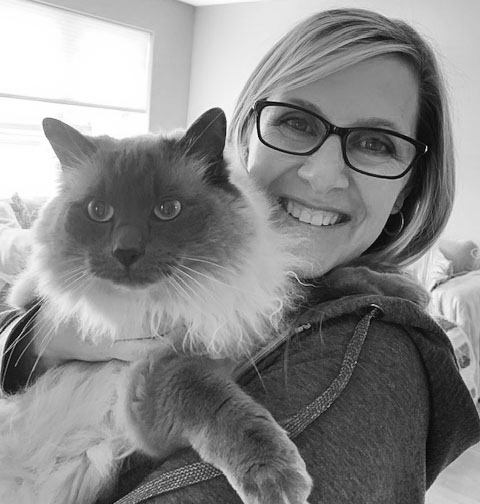


The follow-up visit to the vet opened with the best news I’ve had all summer. Milo’s weight is back up. Nothing is stuck in his mouth or throat. For a 13-year-old cat, our vet told me, he’s in genuinely great shape. Then she asked what he eats.
I told her. She nodded the way people nod when they already know the answer. Then she said the food Milo has eaten his entire life is basically McDonald’s for cats.
In my defense, it’s the only food he has ever agreed to eat. Milo is Balinese. He has opinions, he holds grudges, and he treats new food as a personal insult. So for thirteen years, McDonald’s it was.
The working theory now is that a lifetime of it finally caught up with him: acid reflux irritating his stomach and esophagus, sending meals back up. The fix is a new feeding routine that would be nearly impossible to run by hand. The PetSafe FreshFeed Refrigerated Pet Feeder is what’s making it actually work. Here’s the full story, what this feeder does brilliantly, and where it falls short.
Designed to keep wet or fresh food chilled until scheduled mealtimes, the PetSafe® FreshFeed Refrigerated Pet Feeder uses patented semiconductor technology to help maintain a 40°F* temperature, supporting lasting freshness between meals. With a rotating six-meal tray and app-based scheduling, this refrigerated pet feeder helps make consistent feeding routines easier to manage, even when you’re away from home.
GUARANTEED BEST PRICE
USE COUPON CODE TECHNO30 AT CHECKOUT TO GET $30 OFF
If your cat throws up after eating and your vet has prescribed smaller, more frequent meals, this is the review I wish I’d had in July.
The Backstory, Briefly (and the Feeding Plan That Made This Feeder Necessary)
Quick recap for anyone joining mid-saga. In July, Milo went from occasional hairball drama to throwing up after meals nearly every day. Full workup, a scary weight crash, bloodwork that was helpful but not conclusive. The follow-up visit brought the good news: weight regained, no obstructions, a healthy senior cat in every respect except the one ruining our mornings.
The working theory is acid reflux. Stomach acid irritating his stomach and esophagus, meals coming back up, a cycle that feeds itself. A lifetime of exactly one rich, junky food is the history that makes a vet reach for this theory. It’s not a confirmed diagnosis, but it’s the theory we’re testing with a plan.
The plan has three parts. Transition him to a gentler prescription diet, which he refuses to eat on its own, so we’re mixing it into his old food and shifting the ratio gradually. Feed smaller meals more often, so his stomach never sits empty and no single meal is large enough to come bouncing back. And keep everything wet, because cats are terrible drinkers by design, wet food is roughly 75 percent moisture, and a cat who throws up keeps losing fluids he was never good at replacing – oh, and regular acid-inhibiting medication in both pill and liquid formats, ughhh.
Add it up: a couple of small meals a day, each mixed to a ratio that changes as the transition progresses, all of it wet so none of it can sit out, served on a strict schedule. By hand, that’s a part-time job, and with the summer here and the lake calling my name, I’m not always home to do it. That problem is what the rest of this review is actually about.
| 💡 Pro Tip Transitioning a cat to a new food generally works best over 7 to 14 days, starting mostly-old and shifting the ratio gradually. If your cat is switching foods for a health reason, ask your vet for the exact ratio schedule they want you to follow. And if your cat refuses to eat for more than a day, call the clinic that day. Appetite loss in cats is never a wait-and-see symptom. |
What the PetSafe FreshFeed Actually Is
The PetSafe FreshFeed Refrigerated Pet Feeder is an automatic feeder built for wet, fresh, raw and prescription diets. It uses dual semiconductor cooling to hold food at a constant 40 degrees Fahrenheit inside a rotating six-meal tray, and it serves each meal on a schedule you set in the free PetSafe Pet Companion app. No subscription, for the feeder or the app.
That refrigeration part is the whole reason this product exists. Most automatic feeders are kibble machines. The few that handle wet food usually lean on ice packs, which buy you hours, not days. The FreshFeed is closer to a tiny fridge with a schedule. Five minutes before each serving, the cooling pauses to take the edge off the chill, then the tray rotates the next compartment into the open serving window.
PetSafe FreshFeed at a Glance
| PetSafe FreshFeed at a Glance | |
|---|---|
| Best For | Wet, fresh, raw, or prescription diets that need to run on a schedule. |
| Format | Rotating tray with six compartments, up to 5 fl oz each (about 4.5 cups total). |
| Temperature | Maintains approximately 40°F. Refrigeration pauses five minutes before each scheduled meal so food isn’t served ice cold. |
| App | Free PetSafe Pet Companion app for scheduling meals, receiving notifications, and manual feeding. |
| Power & Wi-Fi | Scheduled meals continue if Wi-Fi disconnects, but the feeder requires continuous wall power and does not include battery backup. |
| Cleaning | Dishwasher-safe stainless steel food inserts, removable tray, and a recommended weekly defrost cycle. |
| Approx. Cost | $249.99 one-time purchase. No subscription required. |
| Main Limitation | Holds six meals per fill, so pets on very frequent feeding schedules may need it refilled every couple of days. |
Setup and First Impressions
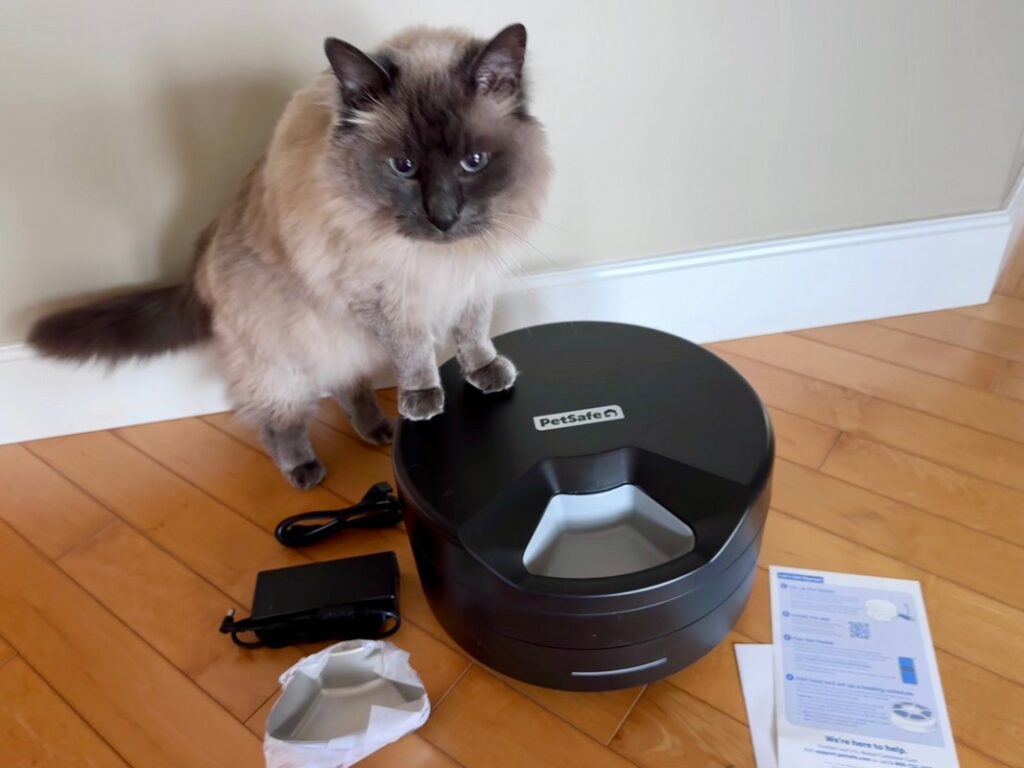
Setup was refreshingly boring for something with a compressor-free refrigeration system inside it. Plug it in, clip the lid latch, pair it with the app over 2.4GHz Wi-Fi, screw the legs to the height you want, load the tray. Fifteen minutes, most of which was me deciding where it should live so the cooling vents had breathing room.
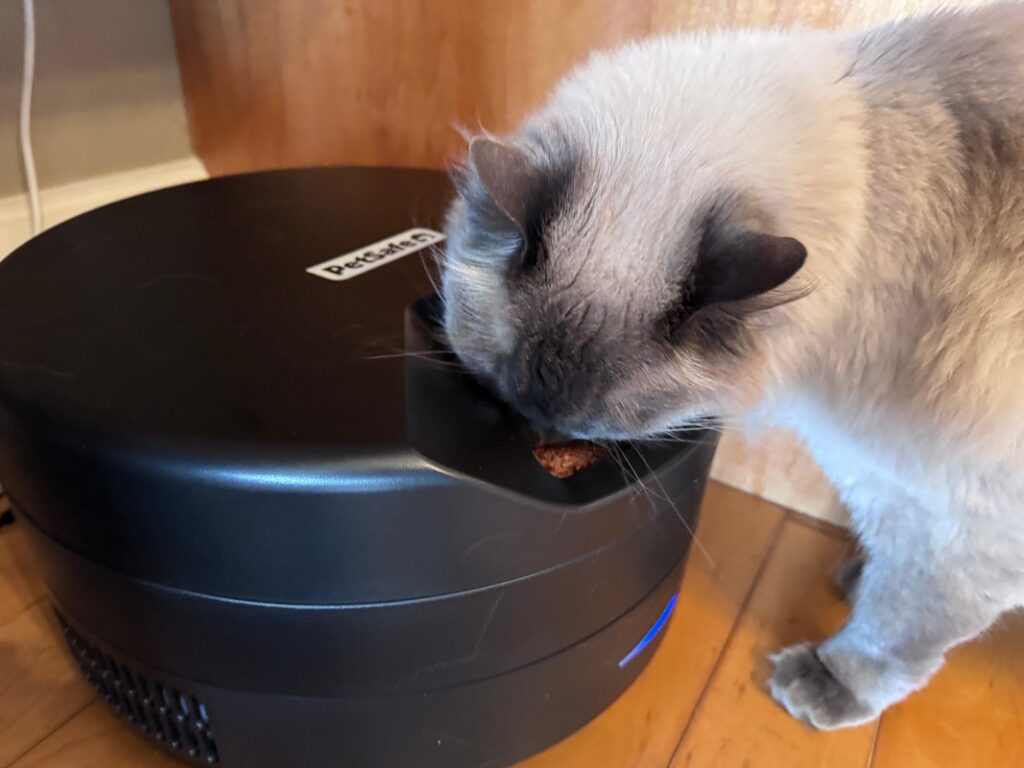
One thing worth knowing before your first fill: the serving window has no door. Whatever sits in the active compartment is available the moment you load the tray. It surprised me, and it surprises most first-time owners, so plan your first fill around it.
| 💡 Pro Tip Since the serving window stays open, load the FreshFeed right at a mealtime and let the exposed compartment be that meal. Your cat eats, meals two through six stay locked and chilled, and nothing sits out unrefrigerated waiting for a schedule to catch up. |
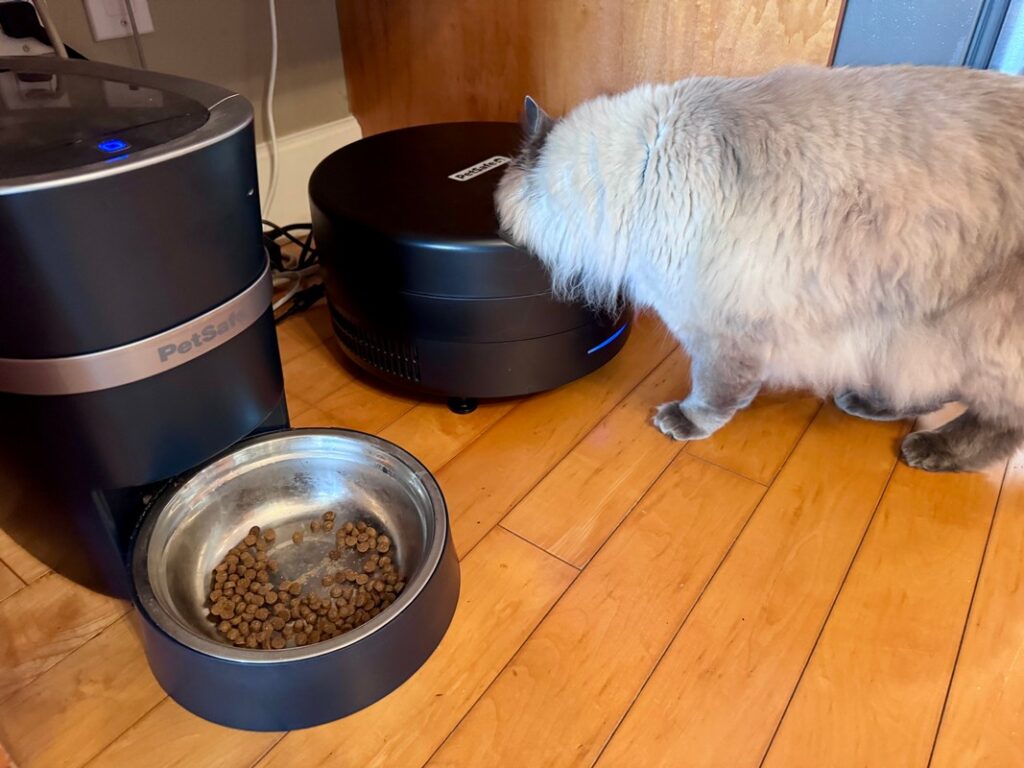
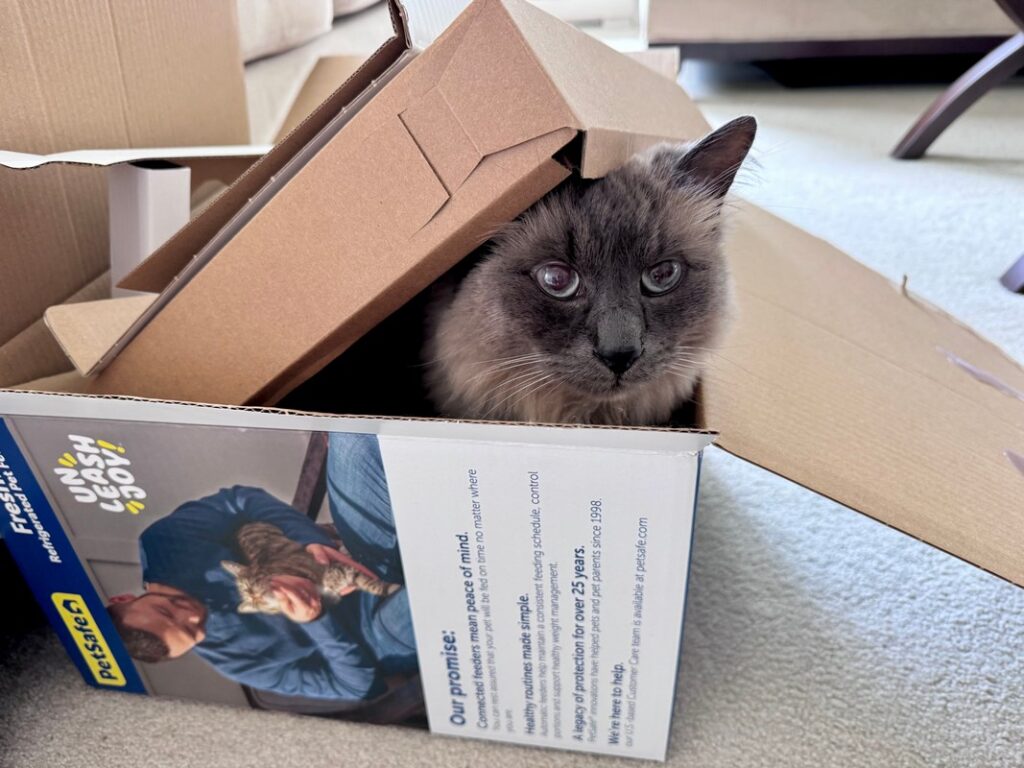
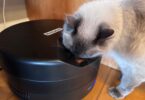
As for Milo: he gave the unit a slow, suspicious tour, sniffed the vents, watched the first rotation from a judgmental distance, and then ate. No standoff. No protest vote. From a cat who treats change as a hostile act, that’s a five-star review.
- True 40°F refrigeration. Keeps wet and fresh food fridge-cold for days. No ice packs to rotate.
- Built for pre-mixed meals. Each compartment holds its own recipe, ideal for transition diets, toppers, supplements and medications.
- Simple, capable app. Scheduling, a notification for every meal served, and a manual feed button that works from anywhere.
- Quiet, paw-safe rotation. A pressure sensor stops and backs the tray up if it senses a paw, then pauses and retries.
- Painless cleanup. Dishwasher-safe stainless steel inserts and a removable tray.
- No subscription. Scheduled meals still serve if the Wi-Fi drops, as long as the unit has power.
- Six meals per fill. That’s a weekend of coverage on a frequent-meal schedule, or about three days at two meals a day.
- No warming option. Refrigeration pauses five minutes before serving, but food still comes out fridge-cool. Some cats will object.
- Sizeable footprint. Roughly 14 inches across, and it needs clearance around its cooling vents.
- No battery backup. After an extended power outage, the unrefrigerated food inside should be replaced.
Real-World Testing: What Sold Me (and What Didn’t)
Pre-mixing meals is the whole ballgame
Here’s the feature nobody puts at the top of the spec sheet, and it’s the reason this feeder earned a permanent spot in my kitchen: every compartment is its own little meal, mixed exactly how you want it.
On Sunday I sit down with the prescription food, the old food and the current ratio, and I build Milo’s meals for the stretch ahead. Compartment by compartment. If the transition plan says the mix shifts midweek, the later compartments just get the new ratio. If he’s having a delicate day, I can vary flavors between morning and evening without being there to do it. Supplements and medications ride along in whichever meal they belong to.
For a healthy cat, that’s a convenience. For a cat mid-transition on a reflux protocol, it’s the difference between following the vet’s plan and approximating it.
The lake weekends
Most weekends in the summer we head up island to our place at the lake, and until now that meant asking someone to come in and feed Milo on Saturday. Under the new protocol, that favor would have ballooned into multiple visits a day. That is a lot to ask of anyone, and honestly, it’s a lot of trust to hand over when the feeding plan is this specific.
Now I load six compartments before we leave, and the schedule runs itself. My phone buzzes each time a meal is served. And honestly? Those notifications do more for my nerves than they do for Milo. There’s a specific kind of peace in seeing “meal served” pop up while you’re standing on a dock two hours from home.
Let’s be honest about the capacity, though. On Milo’s smaller-meals schedule, six compartments covers a weekend almost exactly. At a standard two meals a day, it’s about three days. This is a weekend machine and a busy-week machine. It is not a week-long-vacation machine, and it doesn’t pretend to be one.
On reliability: if the Wi-Fi at home drops while we’re away, scheduled meals still serve, because the schedule lives in the unit. What it can’t survive is a power cut, since there’s no battery backup.
| 💡 Pro Tip A brief power blip is a non-event: when power returns, the FreshFeed resumes its schedule on its own. After an extended outage, though, the food inside has been sitting unrefrigerated, and PetSafe’s own guidance is to stop serving those meals. If you’re away and learn of a long outage at home, treat the rest of the tray as done and arrange a fresh refill. |
The elevated design earned its keep
The FreshFeed stands on adjustable legs, so you can raise or lower the eating position. That sounds like a comfort feature until your vet brings up reflux. An elevated feeding position was one of the levers she suggested we pull: let gravity help food go down and stay down, instead of making a cat eat crouched over the floor.
I raised it so Milo eats with his head up, and mealtimes have been visibly calmer since the whole routine changed. To be fair, I can’t cleanly separate the height from the smaller meals from the new food. It’s all one experiment. But eating posture is part of the plan our vet laid out, and this feeder has it built in, no separate stand required.
The app stays out of the way
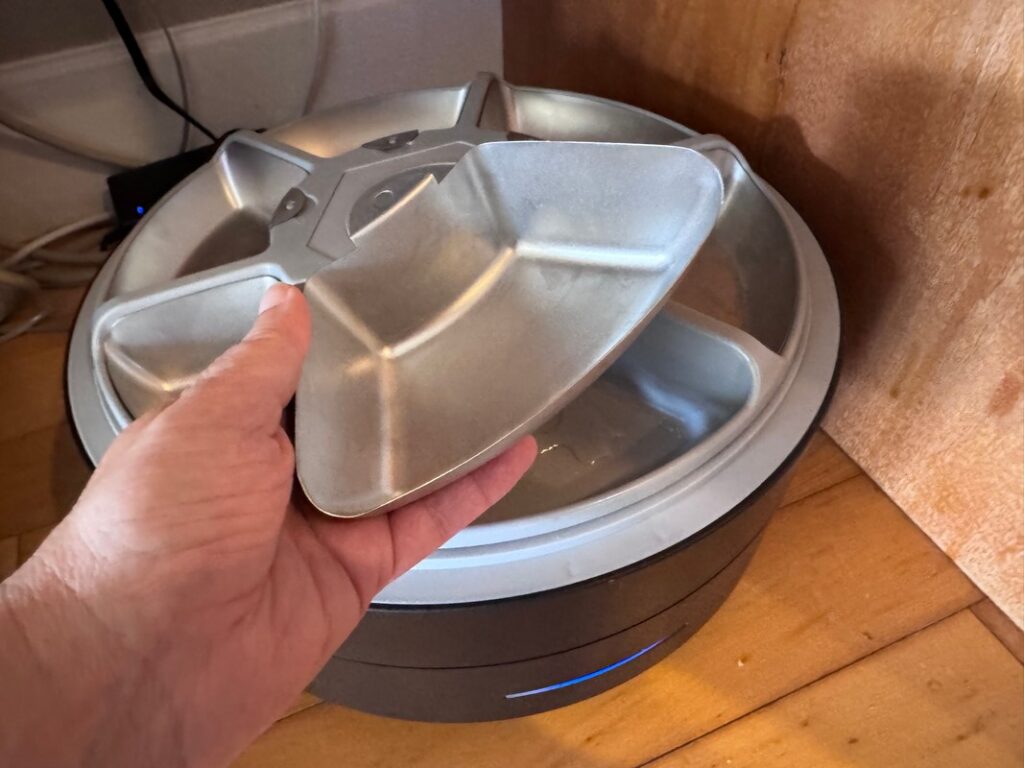
The Pet Companion app is simple in the good way. Set the schedule, get a notification when each meal serves, get a reminder when the tray runs empty. I figured it out without a manual, and I say that as someone who has met a lot of overengineered pet apps.
My favorite button lives right at the top: serve the next meal now. I’ve pressed it from the lake when Milo’s schedule needed a nudge. The feeder de-chills the compartment for five minutes, rotates, and dinner is served while I’m two hours away with a coffee in my hand. It felt faintly ridiculous the first time. Now it feels normal, which might be worse.
One small touch I appreciated: the serving beep can be toggled off. That’s useful during the first week with a timid cat. Once Milo connected the sound to food, I turned it back on, and now it works as a dinner bell. He comes running like the building is on fire, but in a good way.

Cleaning is genuinely painless
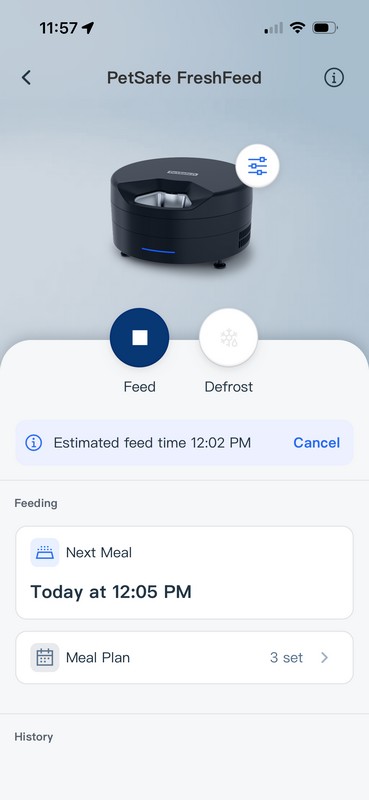
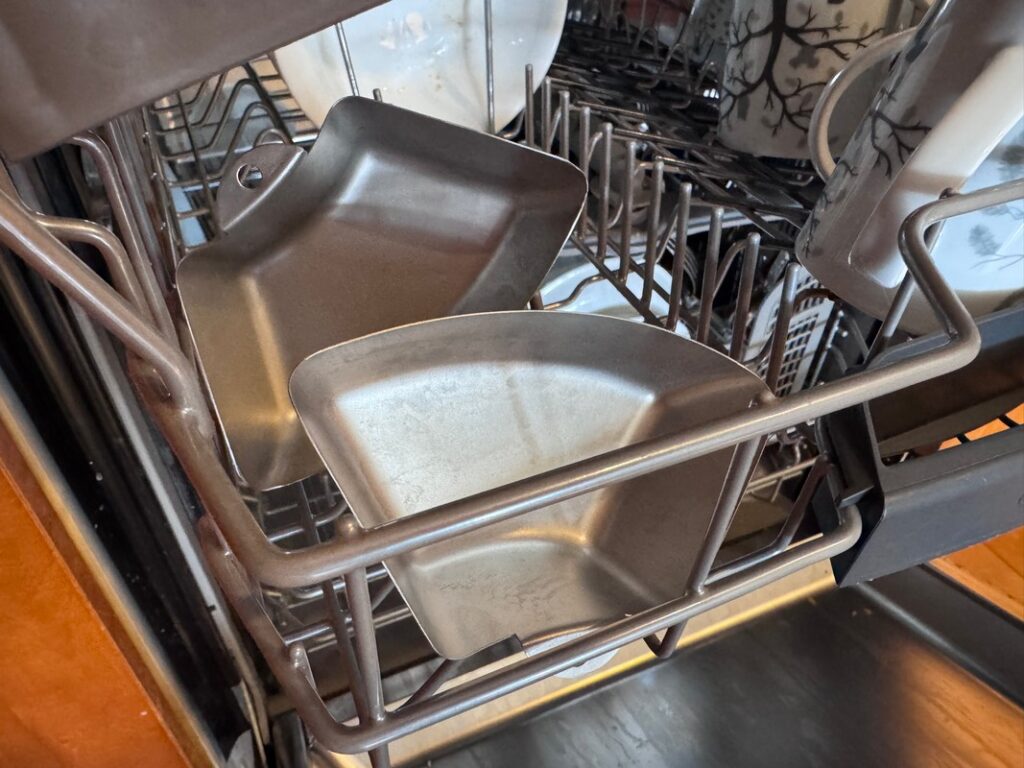
The stainless-steel inserts pop out and go straight into the dishwasher. I tested this claim personally, and repeatedly, because wet food residue is the hill most wet-food gadgets die on. The tray itself lifts out after a twist of the lid, and the unit runs a recommended weekly defrost cycle to keep the cooling system happy.
Wet food gunk is the reason most people quit wet-food gadgets. This one took that excuse away.
The safety details I went looking for
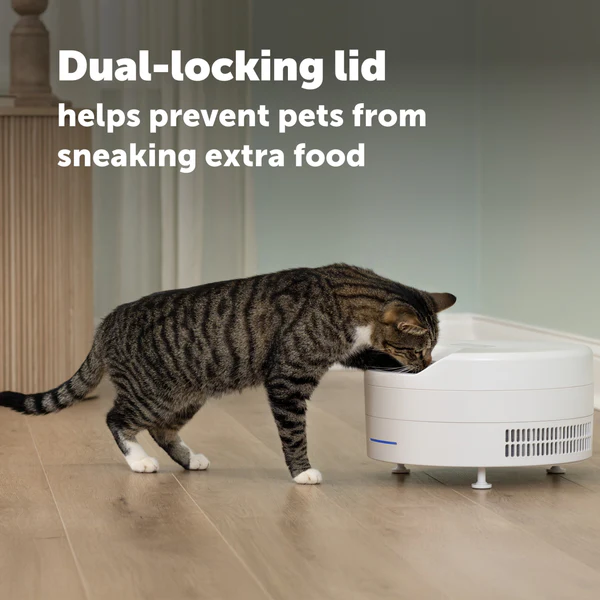
Before I let a motorized tray anywhere near Milo’s face, I wanted answers on two things. First, whiskers and paws: the tray has a pressure sensor, so if it senses a paw while rotating, it stops, backs up, pauses, and then tries again. Second, the compartment stays open until the next scheduled feeding, so nothing closes on a cat mid-meal. Milo has also stood on the lid, stared into it, and pried at the latch with the focus of a small furry safecracker. The dual-locking lid held every time.
What I’d Change
No product is perfect, and a few tweaks would make this one considerably better:
• A warming option. The five-minute cooling pause takes the edge off, but food still serves fridge-cool. Milo didn’t care one bit. Plenty of cats will, and warming is the single most-wished-for feature among early owners. Even ten minutes of gentle warming would end the biggest complaint this product will ever get.
• A slimmer footprint. At roughly 14 inches across, plus clearance for the cooling vents, it claims real floor space. The underside also runs warm, so keep the area beneath and around it clear.
That said, none of these are dealbreakers. They’re the gap between a very good first-generation product and a category-defining one.
Who This Is Best For
Choose the FreshFeed if:
• Your cat eats wet, fresh, raw or prescription food on a schedule
• You’re running a vet feeding protocol: smaller frequent meals, a transition mix, or meals with medications or supplements
• You’re away for weekends and want fed-on-time certainty with a notification for every meal
• You have multiple cats and can run one feeder per cat (the app manages several units on one account, synced to the same clock or staggered)
Skip the FreshFeed if:
• Your cat eats dry kibble twice a day (a simpler feeder does that for far less)
• A food-motivated dog shares the house and can reach the open serving window
• Floor or counter space is genuinely tight
• You’re regularly gone longer than six meals can cover and have no one to refill it
Frequently Asked Questions
Why is wet food important for a cat that throws up?
Hydration. Wet food is roughly 75 percent moisture, while dry kibble sits near 10 percent, and cats have a naturally low thirst drive that rarely makes up the difference at the water bowl. A cat that vomits regularly loses fluids with every episode, so a wet diet quietly replaces them at every meal. That’s part of why vets often steer vomit-prone cats toward wet or fresh food, and it’s the entire reason a refrigerated feeder exists: wet food can’t sit out all day the way kibble can.
How long does food stay fresh inside the FreshFeed?
The FreshFeed holds food at a constant 40°F, the same territory as your refrigerator, so the practical answer is: about as long as that food would last covered in your fridge. For most wet and fresh foods, that comfortably spans a multi-day schedule. Follow the storage guidance on your specific food, particularly for raw diets.
Does the PetSafe FreshFeed require a subscription?
No. The feeder and the Pet Companion app are both subscription-free. Scheduling, notifications and remote feeding are all included in the purchase price.
What happens if the Wi-Fi or power goes out?
Two different answers. If the Wi-Fi drops, scheduled meals still serve, because the schedule lives in the unit itself. If the power goes out, feeding and refrigeration stop, since there’s no battery backup. When power returns, the schedule resumes on its own, but after an extended outage the food inside has gone unrefrigerated and should be replaced rather than served.
Can I mix wet and dry food in the compartments?
Yes. Each compartment holds whatever you put in it, which is the entire point for transition diets like Milo’s. One texture note from experience: kibble sitting against wet food softens over time, so if your cat is fussy about crunch, put mixed meals in the compartments that serve soonest and save wet-only meals for later in the rotation.
Will the rotating tray catch a paw or whiskers?
The tray has a pressure sensor: if it detects a paw while rotating, it stops, backs up, pauses and retries. The open compartment also stays available until the next scheduled feeding, so nothing closes on a cat mid-meal.
Final Thoughts
Milo’s story still doesn’t have a tidy ending, and I’ve made peace with that. The reflux idea is a working theory, not a verdict. What I can tell you is that he’s eating, his weight is holding, the bad mornings are getting rarer, and the transition to better food is actually happening instead of being a thing we keep meaning to start.
The FreshFeed isn’t treating any of that. What it’s doing is making the treatment plan possible. Four precise meals a day, mixed to a ratio, on a schedule that holds whether I’m in the kitchen or on a dock up island. That used to require me, present and organized, seven days a week. Now it requires a Sunday refill and a phone.
Bottom line: $249.99 is real money for a feeder. But I’ve stopped thinking of it as a feeder. It’s the piece of equipment that runs Milo’s feeding plan when I can’t, and it sends me a receipt for every meal. If your cat eats wet or fresh food, follows a special diet, or is one of those cats whose health you think about more than you’d like to, the FreshFeed earns a solid yes.
McDonald’s is off the menu. Milo has, under formal protest, survived the change. And most mornings now, breakfast stays where it’s supposed to. Boring is still the best thing a morning can be.


Leave a Comment