

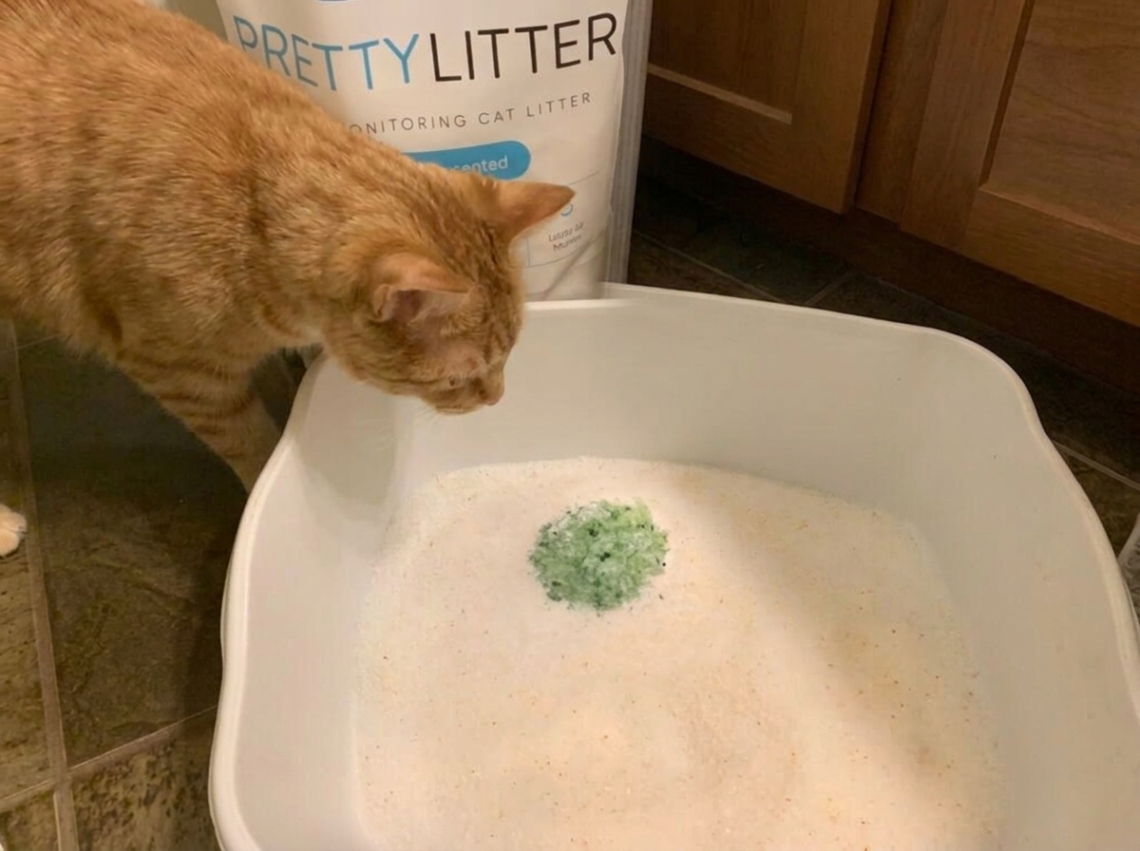
Nobody memorizes the Pretty Litter color chart the day the bag shows up. You look it up at 6 a.m., scoop in one hand, phone in the other, staring at a patch of blue crystals and trying to remember whether blue is the bad one.
And Pretty Litter colors come with more questions than one chart can hold. How worried should I be? Does it matter that the litter is three weeks old? (It does.) And in a multi-cat house, which cat even did this? So we built a decoder that answers all of it in about 15 seconds.
Start Here: The Pretty Litter Color Decoder
Pick the color you're seeing, how long it's been showing up, and how fresh the litter is. The tool hands back an honest urgency tier and your next step. No email, no countdown timer, just the answer. Then keep reading, because the sections below cover the part the official chart skips: the false alarms.
Also, feel free to check out our full Pretty Litter Review here.
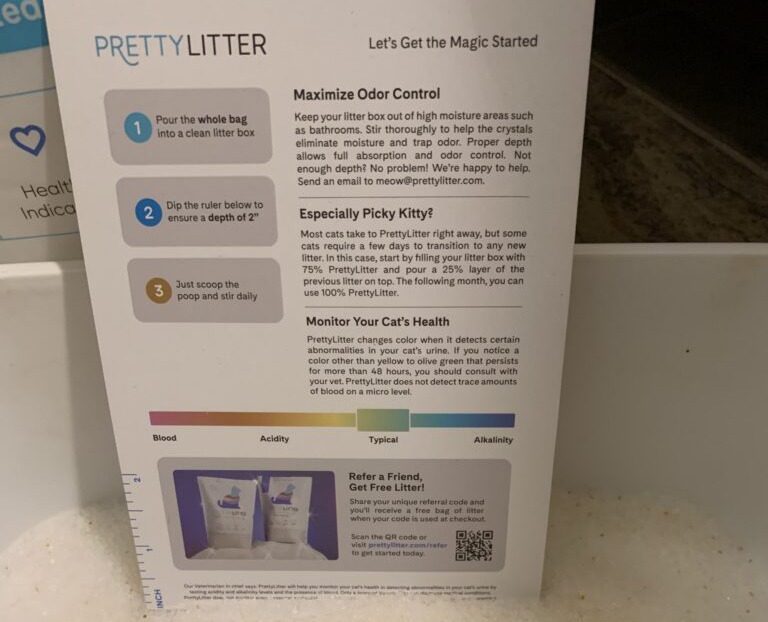
The Pretty Litter Color Chart
If you'd rather scan than tap, here's the full Pretty Litter color chart in one place.
| Color | What It Usually Means | What to Do |
|---|---|---|
| Yellow / Olive Green | Normal urine range. | Nothing to do here. Enjoy the boring. |
| Dark Green / Blue | Alkaline urine, sometimes linked to certain UTIs or struvite crystals. | Watch for 24 to 48 hours and call your vet if it keeps showing up. |
| Orange | Acidic urine, sometimes linked to metabolic issues or calcium oxalate crystals. | Same rule: watch 24 to 48 hours, then call if it persists. |
| Red / Pink | Possible blood in the urine. | Call your vet the same day. |
| Mixed / Unsure | Overlapping deposits or saturated litter. | Refresh that spot and watch the next visit. |
A quick word about red, since it's the one that spikes heart rates. Red doesn't always mean your cat is peeing blood. It does mean the litter detected something that looks like blood, and that's not a wait-and-see situation. Call your vet today, especially with male cats, since urinary blockages can turn dangerous fast. Stay calm, make the call, and let a professional sort it out.

PrettyLitter is a smart, lightweight cat litter with absorbent crystals that trap odors and eliminate moisture. It changes color to monitor your cat's health, detecting issues like UTIs.
LIMITED TIME OFFER: FREE LITTER MAT + 20% OFF
Why the Color Sometimes Lies (In Both Directions)
Here's the thing the marketing understandably doesn't lead with: Pretty Litter can change color when nothing is wrong. Pretty Litter's own guidance says stress, a food change, weather, a new environment, or even a shift in your daily routine can move a cat's urine pH enough to trigger a color. Cats are sensitive little creatures.
That's why the 48-hour rule exists. A single blue or orange reading is a data point, not a diagnosis. If it clears and the next few visits read yellow-green, it was probably a blip. If it keeps showing up across a day or two, that's your cue to call the vet.
One trick experienced Pretty Litter users swear by: when you see blue or orange, scoop out the colored crystals, give the box a stir, and watch the next bathroom trip. A clean, fresh reading means you likely caught a fluke. A repeat means take it seriously. (This retest move is for blue and orange only. Red skips the line. See above.)
| 💡 Pro Tip Before you scoop away a scary color, take a photo. Your vet can learn a lot from the actual shade, and you'll be glad you have it instead of trying to describe "sort of teal" from memory. |
And if you land in that in-between zone, watching a color that won't quite commit, a quick televet visit is a genuinely useful middle step. A service like Dutch Online Vet Telehealth can look at a photo of the litter, talk through what your cat's been doing, and tell you whether this is a wait, a regular appointment, or a get-in-now. Pretty Litter spots the signal, a televet helps interpret it, and your in-person vet treats whatever's actually there.
Check the Clock, Not Just the Color
Here's a detail the official chart never mentions: these colors are on a timer. A change shows strongest in the first hour after your cat goes, and most of it fades within 3 to 4 hours.
That changes how you read the box. A morning scoop is reading overnight deposits at their weakest, so a faint color isn't automatically a mild signal. It might be a strong one that's been sitting for six hours.
The fade isn't even, either. Orange tends to vanish within hours while blue lingers, which explains a question that comes up constantly in owner forums: why do I only ever see blue? If you scoop once a day, orange readings may be coming and going without you ever catching one.
Two takeaways. A vanished color is not an all-clear, so keep the 48-hour watch going even if the patch fades. And if you want honest readings, glance at the box a couple of times a day instead of once.
One Blue Patch, Multiple Suspects
The litter tells you something is off. It cannot tell you who. And here's the pattern that shows up again and again in real owner stories: a color appears, everyone assumes it's the cat with the existing health history, and it turns out to be the "healthy" one who's been quietly hiding under the bed.
So when a color shows up in a shared box:
- Watch every cat, not just the usual suspect. Hiding, sudden clinginess, extra water drinking, and more frequent litter trips are the tells.
- If you can, separate the boxes for a day or two. One cat per box turns a mystery into an answer fast.
- When in doubt, tell your vet it could be any of them. They'd rather check two cats than miss one.
How Long Does Pretty Litter Last? (And Why Old Litter Turns Blue)
How long does Pretty Litter last? One bag per cat for about a month, and that number matters more than it sounds, because old litter doesn't just get smelly. It gets dishonest.
When the crystals reach the end of their absorbent life, urine starts pooling at the bottom of the box, and Pretty Litter confirms that saturated litter can react and turn blue on its own. Slushy texture plus blue color equals a bag that's done, not a cat in crisis.
Think of a reading on month-old litter as a blurry photo. It might show you something real. It might show you a smudge. Either way you can't fully trust it, and "can't fully trust it" is a rough quality for a health monitor to have.
The subscription earns its keep right here. Never hauling litter home is nice, but the real value is fresh crystals on a monthly schedule, so the readings stay worth reading. A health monitor only works if you can believe what it tells you. Plans start around $24 a month for one cat, a little less when you order multiple bags.
| 💡 Pro Tip Pretty Litter is non-clumping, so urine sinks instead of balling up. Scoop all the way to the bottom and give the crystals a daily stir. You'll spot colors sooner, and the bag will actually last the full month. |
Frequently Asked Questions
What does Pretty Litter detect?
Pretty Litter detects shifts in urine pH (alkaline or acidic) and the possible presence of blood. Those cover early signals associated with UTIs, urinary crystals, and kidney or metabolic issues. It's a screening tool, not a diagnostic one, so a persistent color means a vet conversation, not a conclusion.
Can Pretty Litter change color if nothing is wrong?
Yes. Stress, food changes, weather, travel, and new environments can all shift urine pH temporarily. Saturated month-old litter can also turn blue on its own. That's why one reading is a data point and a repeated reading is a phone call.
Can I give my cat something to fix the pH myself?
No. The color is a symptom, not the illness, and home acidifiers won't cure a UTI. Overcorrecting can also push urine acidic enough to form calcium oxalate crystals, a new problem that swinging the pH back cannot undo. Skip the DIY chemistry and treat the cause with your vet.
Does Pretty Litter tell me which cat has the problem?
No. In a shared box, the color flags the household, not the cat. Watch all of your cats for behavior changes, separate the litter boxes for a day or two if you can, and tell your vet it could be any of them. And yes, you need one bag per cat even when they share a box.
Is a red color always an emergency?
Red doesn't guarantee blood, but treat it like it does. Call your vet the same day, especially for male cats, since urinary blockages can escalate within hours. It's the one color where the 48-hour watch rule does not apply.
Final Thoughts
By the way, the win isn't the day it turns blue. It's the 300+ days it doesn't.
Some people genuinely complain that theirs "never changed color," as if a month of steady olive green were a defect. That's the product working. A cat who hides illness professionally (so, every cat) just handed you thirty days of clean readings, and there's real peace of mind in that.
So bookmark the decoder, trust the boring yellow-green, and when a color does show up: check the litter's age, watch the 48-hour window, and make the call when the pattern says to.
Go to: Pretty Litter Health Monitoring Cat Litter Review
PrettyLitter is a smart, lightweight cat litter with absorbent crystals that trap odors and eliminate moisture. It changes color to monitor your cat's health, detecting issues like UTIs. One 8lb. bag lasts up to 2 months, reducing waste and maintenance. With a low-dust, perfume-free formula, it's ideal for single and multi-cat households.
 LIMITED TIME OFFER
FREE LITTER MAT + 20% OFF







Leave a Comment