

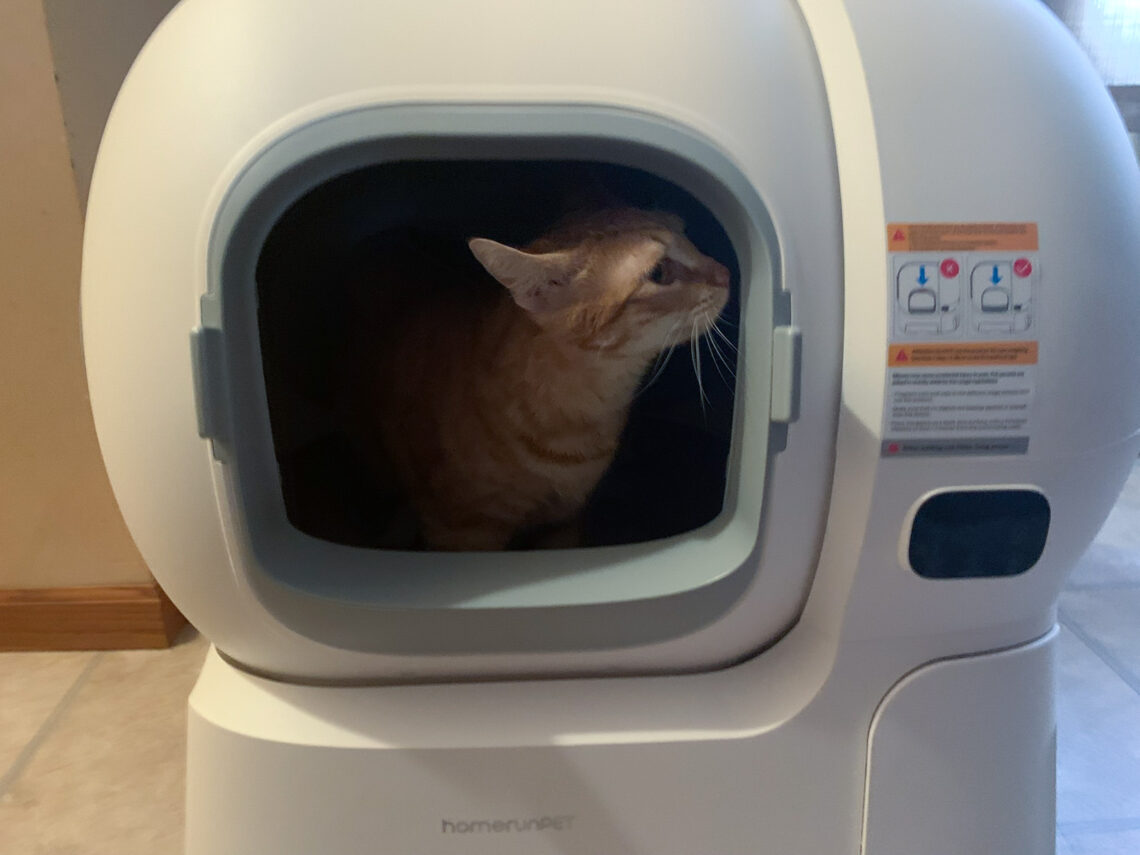
Automatic litter boxes have gotten pretty sophisticated. They can track bathroom habits, control odors, send notifications to your phone and, most importantly, scoop the litter so you don’t have to.
But before I care about any of that, I want to know one thing: Is it safe for my cats?
That’s especially important in my house because I have young cats who absolutely, positively will not leave an automatic litter box alone while it’s cycling.
They hear it start moving and apparently think, “Oh good, something is happening. I should investigate.” Every. Single. Time.
So when I look at an automatic litter box, I’m not thinking about a hypothetical cat who politely uses the box, walks away and minds her own business while it cleans itself. I’m thinking about my cats, who will stick their heads back inside, climb onto it, walk in front of it and generally do everything possible to interfere with the cleaning cycle.
That makes safety features a pretty big deal.
I’ve been using the HomerunPet CS106 Self-Cleaning Litter Box with my cats, and HomerunPet recently shared some interesting news about its safety testing. The CS106 received third-party anti-pinch safety certification from SGS, including testing designed to see what would happen in an extreme situation where the protective software failed.
The HomerunPET CS106 is one of the largest automatic litter boxes I’ve tested, with a roomy 106L dome and oversized 12L waste bin. Designed for big cats and real multi-cat homes, it also features an auto-refill system, ultra-quiet operation, and strong safety sensors. If you want a more hands-off litter setup, this one delivers.
BEST PRICE GUARANTEE
SAVE $60 WITH COUPON CODE PAWZ
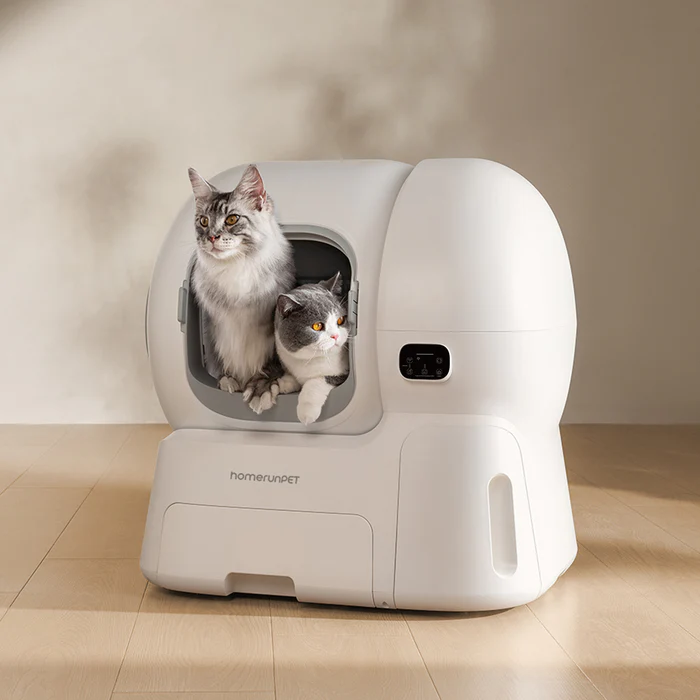
I’ll get more into that below because I think there’s a bigger takeaway here than one certification for one litter box.
If you’re shopping for any automatic litter box, don’t just look at whether it has safety sensors. Look at how those safety systems work together and, perhaps more importantly, what happens if one of them doesn’t work.
1. Look for More Than One Type of Cat-Detection Sensor
Most reputable automatic litter boxes have some way of knowing when a cat is using them. That’s obviously important. You don’t want the cleaning cycle starting with your cat still inside.
But I’d rather see multiple methods of detection than have the entire safety system depend on one sensor.
The HomerunPet CS106, for example, uses both radar and weight sensors as part of its safety system.
That redundancy matters because the box isn’t relying on one single piece of information to determine whether a cat is nearby or inside.
This becomes even more important if you have cats like mine.
My younger cats don’t just use the litter box and walk away. They’ll leave, hear the cleaning cycle begin and immediately come back to see what’s going on. Sometimes they interrupt it repeatedly.
Apparently watching the litter box rotate never gets old. For me, that’s actually one of the easiest ways to see whether the safety systems are doing what they’re supposed to do. If a cat approaches or interferes with the box during a cycle, I want the machine to recognize that and react appropriately.
Want to see the HomerunPET CS106 in action from another point of view? Check out our review video from Fourjollypets below!
2. Make Sure the Box Stops When a Cat Interrupts a Cleaning Cycle
This sounds incredibly obvious, but it’s something I would specifically check before buying an automatic litter box.
What happens if the cat comes back while the box is moving? Because they will.
Maybe not every cat. Perhaps somewhere out there lives a cat who uses an automatic litter box and then respectfully gives the machine some privacy while it finishes its work.
I don’t own that cat. Well, okay, Zoe is pretty chill about the whole thing. The other 5? Not so much.
Young cats in particular can be curious about the movement and noise. In a multi-cat household, you can also have another cat wander over while the box is cleaning after the first one.
A good automatic litter box should detect that interruption and stop its cleaning cycle rather than assuming that once the cat has left, the coast is clear.
This is also why I wouldn’t disable safety features because your cat keeps interrupting the cycle and the box takes forever to finish cleaning. Yes, it can be mildly annoying when the machine has stopped for what feels like the 47th time because somebody needs to inspect it again.
I’d much rather have an overly cautious litter box than one that prioritizes finishing the cleaning cycle.
3. Look at the Physical Design, Not Just the Sensors
This is one of the biggest things I think people overlook when comparing automatic litter boxes. Sensors are important, but the physical design of the machine matters, too.
Think about what actually moves during a cleaning cycle. Does the entrance change size or shape as the drum rotates? Are there areas where two moving parts come together? Could a paw or tail potentially end up between them? Could the opening become blocked?
Basically, look at the litter box as a machine rather than just a litter box.
The CS106 has a physical anti-pinch escape channel built into its design. It’s the only automatic litter box I’ve seen that includes this feature. That gives it another layer of protection beyond the radar and weight sensors.
And that’s where HomerunPet’s recent SGS testing gets particularly interesting.
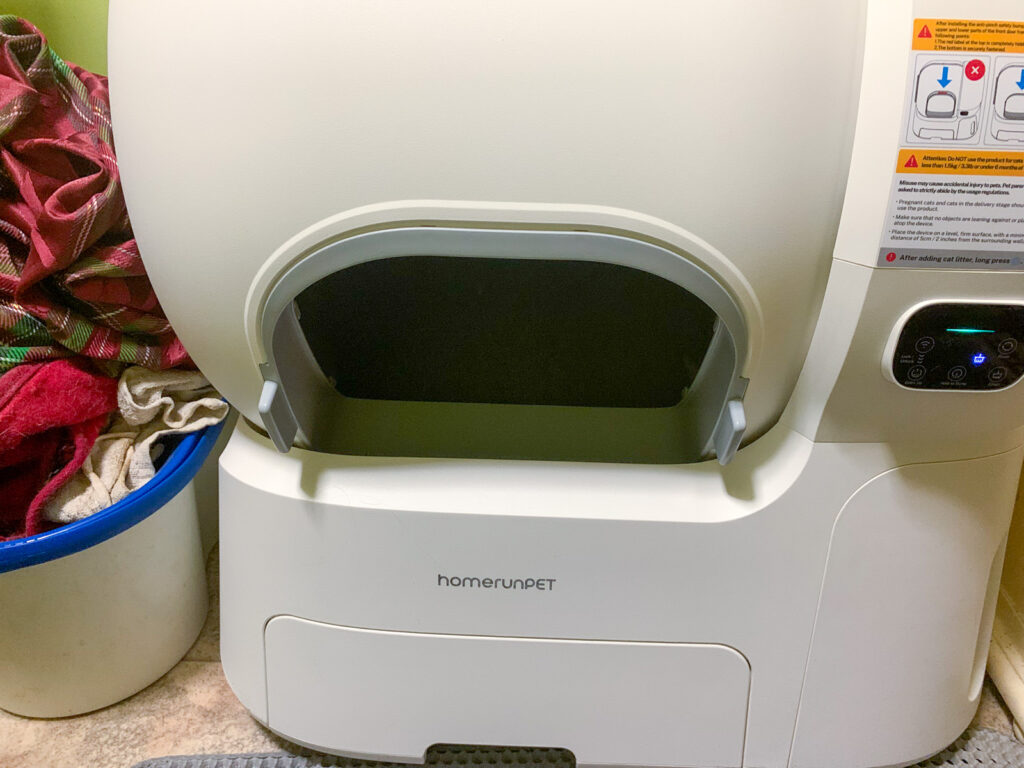
4. Look for a Physical Fail-Safe That Doesn’t Depend on Software
Smart litter boxes are still computers controlling motors. Computers occasionally decide not to computer correctly.
That’s why I really like seeing a physical safety feature that doesn’t depend entirely on software doing what it’s supposed to do.
HomerunPet’s CS106 recently underwent third-party anti-pinch safety testing through SGS, an independent testing, inspection and certification organization.
What caught my attention wasn’t simply that the CS106 received a safety certification. It was what SGS tested.
According to the certification documentation, the testing simulated an extreme scenario in which the litter box’s protective software failed.
Under normal operation, the software prevents the rotating drum from reaching the mechanical latch position when doing so could create a safety issue. SGS evaluated the physical anti-pinch design under a scenario where that software protection was assumed to fail.
In other words, the test wasn’t simply asking: “Is this litter box safe when everything works exactly as intended?”
It also looked at: “What happens if the software doesn’t?”
That’s a much more useful question. The CS106 essentially has three layers of protection: radar detection, weight sensing and the physical anti-pinch design.
The first two help the litter box detect the cat and respond appropriately. The physical design provides another layer of protection that doesn’t depend solely on those electronic systems.
That’s the kind of redundancy I want to see in something that’s going to operate around my cats when I’m not necessarily standing there watching it.
5. Check the Minimum Weight and Age Requirements
Automatic litter boxes aren’t automatically appropriate for every cat. Pay particular attention to the manufacturer’s minimum weight recommendations if you have a kitten or a very small cat.
Weight sensors obviously need enough weight to detect that something is there. A tiny kitten may physically be able to climb into an automatic litter box before they’re large enough to reliably trigger all of its safety systems.
That’s one reason I wouldn’t assume that “my kitten can get into it” means “my kitten is ready to use it unsupervised.”
Check the manufacturer’s recommendations for the specific model you own or are considering. And if your kitten is right around the minimum, I’d err on the cautious side.
You can always use a regular litter box a little longer. The robot isn’t going anywhere.
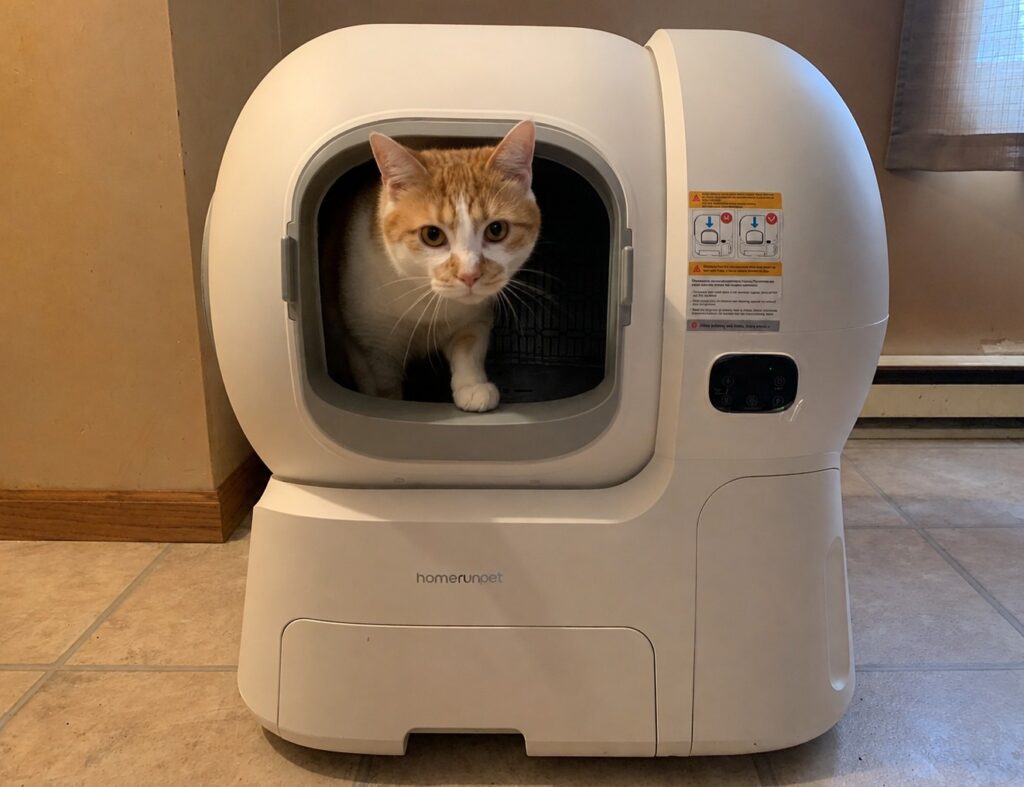
6. Find Out What Happens If the Power or Software Fails
We tend to evaluate smart pet products based on what they can do when everything is working. But I think safety requires asking the opposite question: What happens when something goes wrong?
- What happens during a power outage?
- What happens if the software freezes?
- What happens if a sensor stops responding?
- Can your cat still easily get out of the litter box?
- Does the box remain accessible when it isn’t powered?
- Could any moving component leave the entrance in a dangerous position?
This is another reason I like passive physical safety features. They aren’t dependent on Wi-Fi, an app, a firmware update or even electricity. Ideally, an automatic litter box should fail in the safest possible way.
7. Look for Independent Safety Testing
Manufacturers can tell us all day long that their products are safe. Obviously, they should believe their products are safe before selling them.
But independent testing adds another level of reassurance.
That’s why I think the SGS testing on the HomerunPet CS106 is worth mentioning beyond the fact that HomerunPet can now put another certification on the product page.
The testing specifically evaluated the anti-pinch design under an extreme software-failure scenario. That’s meaningful because it addresses one of the questions I think consumers should be asking about all automatic litter boxes:
Is the safety system still protective if one part of it fails?
That doesn’t mean any automatic litter box is completely risk-free, of course. It’s still a machine with moving components, and you still need to use it according to the manufacturer’s instructions.
But I’d put far more confidence in a product with several independent layers of protection than one whose entire safety strategy comes down to “the sensor should stop it.”
Why Layered Safety Matters So Much to Me
After using automatic litter boxes in a house with multiple cats, I’ve realized that my biggest concern isn’t how the machine behaves when everything goes perfectly.
It’s how it responds to cats being cats. My cats don’t read instruction manuals. They don’t know they’re supposed to leave the litter box alone while it cycles. My younger cats seem almost personally offended by the idea.
And frankly, I don’t want their safety to depend on them behaving predictably. That’s what I like about the layered approach used by the HomerunPet CS106. You have radar and weight sensors designed to detect the cat, plus a physical anti-pinch design as another line of protection.
If one system is responsible for everything, one failure can potentially become a much bigger problem. With multiple layers, another safety mechanism is there as backup.
That principle applies whether you’re considering the CS106 or another automatic litter box.
Automatic Litter Box Safety Checklist
Before buying an automatic litter box, I’d look for:
- Multiple methods of detecting a cat
- Automatic stopping when a cat approaches or enters during a cleaning cycle
- A physical design that minimizes pinch and entrapment points
- A safe, accessible exit throughout the cleaning process
- Physical or mechanical fail-safes that don’t rely entirely on software
- Clear minimum age and weight requirements
- Safe behavior during power or software failures
- Independent safety testing when available
And once you bring the box home, watch your cats use it for a while before you completely trust the machine to handle things on its own.
Not just because you need to know how the litter box works. You need to know how your cat interacts with it.
Some cats will use an automatic litter box and never give the cleaning cycle another thought. Others will hear the motor start from three rooms away and come running because apparently the litter box has scheduled today’s entertainment.
I have the second kind.
The Bottom Line: Don’t Just Ask What Happens When Everything Works
Automatic litter boxes are one of my favorite pet-tech conveniences. With multiple cats, not having to manually scoop every single deposit is a beautiful thing. But convenience doesn’t outrank safety.
When you’re comparing automatic litter boxes, don’t stop at “Does it have safety sensors?”
Dig a little deeper.
How many safety systems are there? What does each one do? What happens if your cat interrupts the cleaning cycle? What happens if a sensor, the software or the power fails? And is there a physical backup if the electronic safeguards don’t work as intended?
That’s what makes the SGS testing of the HomerunPet CS106 interesting to me. The certification itself is nice, but the bigger story is the philosophy behind the design: don’t rely on one safety feature when you can build in several.
Because you can design the smartest litter box in the world. You still have to design it for the cat who hears it start rotating and thinks, Wait. I need to stick my head in there. And apparently, I own several of those.
The HomerunPET CS106 is one of the largest automatic litter boxes I’ve tested, with a roomy 106L dome and oversized 12L waste bin. Designed for big cats and real multi-cat homes, it also features an auto-refill system, ultra-quiet operation, and strong safety sensors. If you want a more hands-off litter setup, this one delivers.
BEST PRICE GUARANTEE
SAVE $60 WITH COUPON CODE PAWZ





Leave a Comment